


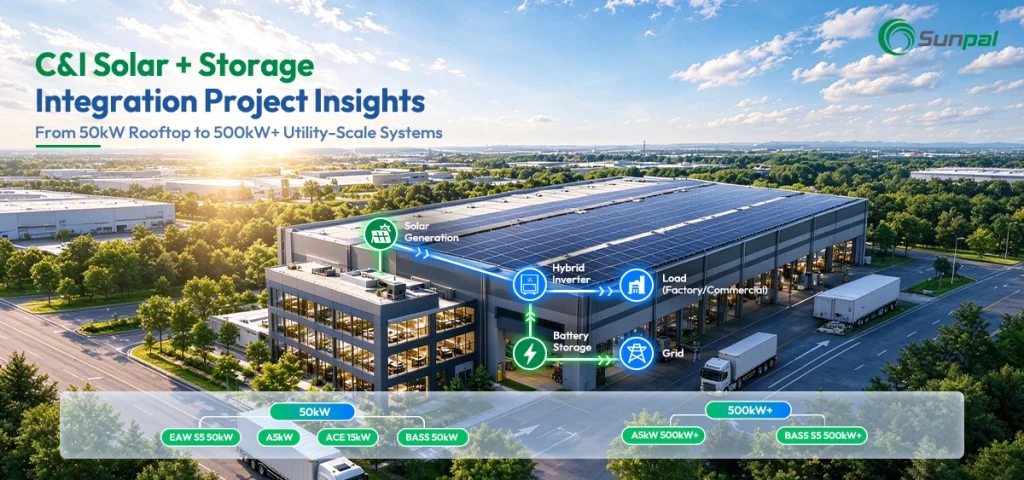
Commercial and industrial solar is moving toward larger, more flexible and more integrated energy systems. From 50kW rooftop installations for small and medium-sized businesses to 500kW+ systems serving factories, logistics centers and large commercial facilities, project design is increasingly shaped by electricity consumption profiles, available installation area, grid requirements, energy storage and long-term operating objectives.
For businesses evaluating a new photovoltaic project, system capacity is only one part of the decision. Module technology, inverter selection, electrical architecture, battery storage, energy management and local interconnection requirements can all influence the technical and financial performance of the final system.
This makes the selection of an experienced EPC, system integrator or solar supplier an important part of the project-development process.
What Is Commercial and Industrial Solar Solutions?
Commercial and Industrial (C&I) solar solutions are photovoltaic energy systems designed for businesses, industrial facilities, agricultural operations, warehouses, offices, retail buildings and other non-residential applications.
Unlike a standard residential installation, C&I projects often have:
- Higher electricity consumption
- Three-phase electrical infrastructure
- Larger rooftop or ground-mounted arrays
- More complex load profiles
- Commercial grid-interconnection requirements
- Demand-charge considerations in applicable markets
- Optional battery energy storage
- Advanced monitoring and energy-management requirements
A typical C&I system combines photovoltaic modules, inverters, mounting structures, electrical protection, monitoring equipment and grid-interconnection equipment. Larger installations can also incorporate BESS, EMS, backup power and other energy-management functions.
For example, the current Sunpal commercial inverter portfolio includes three-phase hybrid inverter solutions designed for commercial and industrial PV projects. One example is the Sunpal 100kW/150kW Three-Phase Hybrid Solar Inverter, designed for larger commercial and industrial applications and compatible with different solar panel, energy storage, and commercial solar system configurations. It supports high-power PV input, multiple MPPT channels, battery charging and discharging, and flexible grid interaction for efficient energy management.
Who Is This Solution For?
C&I solar can be considered by organizations with significant daytime electricity consumption or sufficient roof, parking or ground area for PV deployment.
Typical project profiles include:
| Project Profile | Typical Solar Strategy | Key Considerations |
|---|---|---|
| Small commercial building | 50–100kW rooftop PV | Roof area, daytime load, grid connection |
| Supermarket or retail facility | 100–300kW PV + optional BESS | Refrigeration, HVAC and peak demand |
| Factory or workshop | 200–500kW+ PV | Machinery load, transformer capacity, operating hours |
| Logistics warehouse | 300–500kW+ rooftop PV | Large roof area, daytime consumption |
| Agricultural facility | 50–500kW+ PV + optional storage | Pumps, irrigation, refrigeration and rural grid |
| Large industrial site | 500kW+ PV + BESS/EMS | Load profile, interconnection and power quality |
| Urban commercial building | Rooftop + photovoltaic facade systems | Limited roof area and architectural integration |
The appropriate system should therefore be determined from actual energy consumption and site conditions rather than capacity alone.
Applications and Ideal Project Profiles
The global C&I market includes several different architectural and operational environments.
PV Systems in Different Application Scenarios
Custom PV & energy storage solutions for factories, warehouses and commercial parks.
50kW to 100kW Commercial Systems
A 50kW-class system can be an appropriate starting point for smaller factories, workshops, supermarkets, offices, agricultural buildings and hospitality facilities.
At this scale, the project may use multiple string inverters or a commercial inverter such as a 50kW-class three-phase unit.
The important design questions include:
- How much electricity is consumed during daylight hours?
- Is the roof structurally suitable?
- How much unshaded area is available?
- What is the existing AC voltage?
- What is the permitted grid-export capacity?
- Is battery storage required?
100kW to 500kW Commercial Systems
The 100–500kW segment is relevant to medium-sized factories, warehouses, retail facilities, agricultural processing plants and regional distribution centers.
These projects can benefit from:
- Multiple MPPT inputs
- String-level monitoring
- High-current PV inputs
- Commercial EMS
- Optional BESS
- Remote O&M
- Modular inverter architecture
A project may also combine several commercial inverters rather than relying on a single centralized conversion unit.
500kW+ Solar Systems
A 500kw+ solar system generally requires more detailed electrical, structural and financial engineering.
Large systems may be deployed on:
- Manufacturing facilities
- Logistics warehouses
- Distribution centers
- Large commercial campuses
- Data centers
- Agricultural processing sites
- Ground-mounted commercial sites
At this scale, the design process should consider transformer capacity, medium-voltage infrastructure, protection coordination, utility interconnection, power quality, cable losses, monitoring and potentially battery storage.
The term 500kw solar system can therefore describe a system at a specific nominal capacity, while 500kw+ solar system covers a broader range of larger C&I deployments.
50kW vs. 500kW+ Solar System Comparison
Capacity alone does not determine the quality or financial performance of a project. The following comparison provides an initial planning framework rather than a fixed engineering specification.
| Feature | 50kW Solar System | 500kW+ Solar System |
|---|---|---|
| Typical application | Offices, workshops, small retail, agricultural buildings | Factories, logistics centers, large commercial sites |
| PV modules | Commercial high-efficiency modules | High-efficiency modules, often optimized for large-scale deployment |
| Inverter architecture | One or several commercial string inverters | Multiple commercial string inverters or larger centralized architecture |
| Roof/land requirement | Relatively compact | Large rooftop, carport or ground-mount area |
| Electrical design | Low-voltage commercial connection may be possible | More complex LV/MV and transformer design may be required |
| Monitoring | Inverter and site monitoring | Advanced plant monitoring, EMS and asset management |
| BESS | Optional | Increasingly relevant where peak shaving, backup or energy shifting is required |
| Engineering complexity | Moderate | High |
| Interconnection study | Depends on local utility | Frequently more significant |
| Best sizing method | Load profile + available roof | Load profile + grid + site + financial model |
Important: Actual generation, roof area and system economics vary significantly by module power, orientation, shading, climate, irradiance, system losses and local regulations. Capacity should not be translated directly into a universal annual-generation figure.
System Architecture and Main Components
A modern commercial solar installation typically connects several energy assets into one coordinated system.
Simplified C&I Solar System Diagram
                   SOLAR PV ARRAY
                         │
                         ▼
              ┌─────────────────────┐
              │ DC Combiner /       │
              │ Protection          │
              └─────────┬───────────┘
                        │ DC
                        ▼
              ┌─────────────────────┐
              │ Commercial PV       │
              │ Inverter            │
              │ 50kW / 100kW / ...  │
              └─────────┬───────────┘
                        │ AC
                        ▼
              ┌─────────────────────┐
              │ AC Distribution /   │
              │ Protection          │
              └───────┬─────┬───────┘
                      │     │
                      │     ▼
                      │  ┌───────────┐
                      │  │ Commercial│
                      │  │ Loads     │
                      │  └───────────┘
                      │
                      ▼
                ┌───────────────┐
                │ Grid / Utility │
                └───────────────┘

              OPTIONAL ENERGY STORAGE
                       ▲
                       │
              ┌────────┴────────┐
              │ Hybrid / PCS    │
              │ + BESS          │
              └────────┬────────┘
                       │
                       ▼
                    Battery

                ┌─────────────┐
                │ EMS / SCADA  │
                │ Monitoring   │
                └─────────────┘
The final architecture depends on whether the project is grid-connected, hybrid, backup-oriented or designed for more advanced energy-management applications.
1. Solar Modules
High-efficiency monocrystalline modules are widely used in commercial projects because higher module power can help reduce the number of modules, mounting components and DC connections required for a given system capacity.
Bifacial modules can also be considered where the installation environment provides sufficient rear-side irradiance.
2. Commercial Inverters
Inverters convert PV-generated DC electricity into AC electricity for site consumption or grid export.
For example, the Sunpal IESP500SH3, IESP550SH3, and IESP600SH3 are 50kW, 55kW, and 60kW three-phase hybrid inverters for commercial and industrial applications. They feature 4 independent MPPT trackers, support up to 1000V DC PV input, and provide a 150–820V battery voltage range with dual battery inputs. The series supports three-phase unbalanced loads up to 100%, with RS485/CAN/USB communication and IP65 protection.
For larger C&I projects, the Sunpal MPS 100kW/150kW three-phase hybrid inverter supports up to 1000V DC PV input, with conversion efficiency up to 98.6% and MPPT tracking accuracy of 99.9%. It supports on-grid and off-grid operation, battery integration, and communication through RS485, CAN, Modbus, and Wi-Fi, making it suitable for higher-capacity commercial PV and energy storage configurations.
3. Battery Energy Storage
Battery storage is optional rather than mandatory for every commercial PV system.
A BESS may be considered for:
- Peak shaving
- Energy shifting
- Backup power
- Self-consumption optimization
- Grid-support functions
- Time-of-use energy management
Sunpal also offers commercial hybrid inverter solutions. Its 50kW/55kW/60kW three-phase hybrid inverter series is designed for commercial energy storage and supports high-voltage battery integration, parallel operation, and peak-shaving functions.
4. Energy Management System
An EMS can monitor PV production, battery state of charge, electricity consumption and grid conditions.
For larger projects, EMS functionality can become particularly important because the objective is no longer simply to maximize PV generation. The system may need to coordinate solar production, battery operation, site loads and grid constraints.
Technical Design and Sizing Criteria
How Is the System Sized?
A commercial PV system should normally be sized using a combination of energy consumption, load profile, site conditions and grid requirements.
A simplified first-stage approach is:
PV Capacity ≈ Target Annual Energy Offset ÷ Specific Annual PV Yield
However, this formula is only an initial screening method. A professional design should also consider hourly consumption and generation.
Key inputs include:
- Annual electricity consumption
- Hourly or 15-minute load data
- Daytime versus nighttime consumption
- Utility tariff structure
- Demand charges, where applicable
- Export compensation
- Roof or ground area
- Roof orientation and tilt
- Shading
- Module temperature conditions
- Inverter MPPT characteristics
- DC/AC ratio
- Grid interconnection limit
- Transformer capacity
- Battery requirements
- Local electrical codes
For a 50kW project, the main challenge may be finding the right balance between roof capacity and electricity consumption. For a 500kW+ project, electrical infrastructure and grid interconnection can become equally important as the PV array itself.
Product Selection and Supplier Evaluation
How Should an EPC or Supplier Be Evaluated?
Selecting a supplier should involve more than comparing module or inverter prices.
A commercial buyer can evaluate suppliers using the following criteria:
| Evaluation Area | Questions to Ask |
|---|---|
| Product quality | Are datasheets and certifications available? |
| Inverter compatibility | Can the inverter support the selected module electrical characteristics? |
| System design | Does the supplier provide string design and electrical calculations? |
| Energy storage | Can BESS be integrated if required? |
| Monitoring | Is remote monitoring available? |
| Warranty | What are the product and system warranty conditions? |
| O&M | Who handles commissioning and long-term service? |
| Spare parts | Are replacement components accessible? |
| Compliance | Does the equipment meet applicable local standards? |
| Project experience | Can the supplier provide documented project references? |
| Customization | Can the architecture be adapted to the site's load and grid? |
| Communication | Is there technical support during installation and commissioning? |
Why Inverter Selection Matters
A commercial inverter should be evaluated against the PV array rather than selected only by nominal AC capacity.
Important specifications include:
- Maximum DC voltage
- MPPT voltage range
- Maximum input current
- Number of MPPTs
- Maximum AC output
- Efficiency
- Operating temperature
- Environmental protection
- Grid-support functions
- Monitoring capability
- Applicable certifications
The Sunpal MPS 100kW/150kW three-phase hybrid inverter series, for example, features multiple MPPTs and supports high-voltage PV and battery configurations for larger commercial and industrial applications.
Installation, Commissioning and Operations
A C&I solar project should follow a structured development and commissioning process.
C&I Solar EPC Workflow
A structured five-stage execution sequence for commercial & industrial solar projects — from site assessment and PV installation through inverter & BESS integration, commissioning, and long-term O&M monitoring.
Sunpal EPC Delivery Capability
Highlight: BESS is integrated into Stage 3 as an optional system component, showing how storage interacts with the inverter, protection scheme and monitoring platform.
Stage 1: Site Assessment
The EPC or engineering team evaluates:
- Roof condition
- Structural loading
- Shading
- Electrical infrastructure
- Transformer capacity
- Cable routes
- Fire-safety requirements
- Equipment access
Stage 2: Electrical Design
The engineering package should define:
- Module strings
- MPPT allocation
- DC/AC ratio
- Inverter configuration
- DC and AC cable sizing
- Protection devices
- Earthing
- Surge protection
- Distribution equipment
- Grid-interconnection point
Stage 3: Installation
Construction typically covers module mounting, inverter installation, DC wiring, AC distribution, monitoring equipment and optional BESS installation.
Stage 4: Commissioning
Commissioning should verify:
- String polarity
- Insulation resistance
- Open-circuit voltage
- Inverter configuration
- Protection functions
- Communications
- Metering
- Grid synchronization
- Monitoring
- Battery operation, where applicable
Stage 5: O&M
Long-term operation should include:
- Performance monitoring
- Fault alerts
- Preventive maintenance
- Inverter inspection
- Electrical inspections
- Module cleaning where justified
- Thermal inspection when appropriate
- Performance-ratio tracking
Cost, ROI and Risk Considerations
Commercial solar investment should be evaluated as an infrastructure project rather than simply a hardware purchase.
Capital Cost
The final cost can be influenced by:
- Module selection
- Inverter quantity
- Mounting structure
- Roof reinforcement
- Electrical equipment
- Transformer requirements
- Installation labor
- Engineering
- Permitting
- Interconnection
- BESS
- EMS
- Site-specific civil works
Electricity Savings
The value of solar depends heavily on the site's electricity tariff and self-consumption rate.
A facility with significant daytime electricity demand may consume a large proportion of its solar generation directly. Another facility with low daytime demand may depend more heavily on export arrangements or battery storage.
Incentives
Incentives should always be checked against the project's location, ownership structure, commissioning date and eligibility requirements.
For example, USDA's Rural Energy for America Program (REAP) provides funding opportunities for eligible agricultural producers and rural small businesses, although program availability and application status can vary by location and time.
A documented USDA example also shows how solar can be integrated into agricultural operations: Replenova Farm in Maine installed solar for its farm store, commercial kitchen, coolers and high tunnels, with an $8,000 REAP grant contributing to a project costing more than $52,000. USDA reported that the project had paid for itself through energy savings by 2024.
This illustrates why project-specific financial analysis is more useful than applying a universal payback assumption.
Main Project Risks
C&I solar developers should consider:
- Roof structural limitations
- Interconnection delays
- Utility export restrictions
- Equipment lead times
- Electricity-price changes
- Construction conditions
- Equipment compatibility
- Inverter downtime
- Battery degradation
- Regulatory changes
- Financing conditions
A detailed feasibility study can identify many of these risks before construction begins.
SUNPAL PV Project Support
Commercial solar projects require coordination between product selection, system design, electrical engineering and project execution.
SUNPAL PV can support commercial and industrial solar projects across different system capacities and application scenarios, including rooftop PV, commercial solar systems, hybrid PV and battery-storage configurations.
For projects ranging from approximately 50kW to 500kW+, the design process can be structured around:
- Site and load analysis
- PV module selection
- Inverter configuration
- Commercial system architecture
- Battery-storage integration
- EMS requirements
- System sizing
- Project-specific equipment configuration
- Technical documentation
- Project support
The objective is not simply to select a larger solar system. It is to develop a configuration that fits the facility's electricity consumption, available installation area, grid conditions and long-term operating requirements.
Provide your project location, electricity bills or load profile, available roof/ground area and target system capacity. A project-specific configuration can then be developed around your actual operating conditions rather than a generic 50kW or 500kW template.
Frequently Asked Questions
What is a commercial and industrial solar system?
A commercial and industrial solar system is a photovoltaic installation designed to supply electricity to businesses, factories, warehouses, agricultural facilities, offices and other non-residential sites.
What is a typical 50kW solar system used for?
A 50kW system can be suitable for smaller commercial buildings, workshops, agricultural facilities, retail sites and other businesses with sufficient electricity consumption and installation space.
What is a 500kw solar system?
A 500kW solar system has a nominal PV capacity of approximately 500kW. The actual annual energy output depends on location, solar irradiation, orientation, shading, module technology, system losses and other design conditions.
What does 500kw+ solar system mean?
The term refers to commercial or industrial PV systems exceeding approximately 500kW. These systems can involve more complex electrical infrastructure, grid interconnection and project engineering.
Why are MPPTs important in a commercial inverter?
Multiple MPPTs allow different PV strings or roof sections to operate under different electrical conditions. This can be useful when a commercial building has multiple roof orientations, different shading conditions or varied string configurations.
Is the Sunpal 50kW inverter suitable for commercial projects?
A Sunpal 50kW-class inverter can be suitable for small and medium-sized commercial and industrial PV projects, depending on the system capacity, load profile, grid requirements, and installation conditions. For larger C&I systems, multiple inverters can be configured to achieve the required PV capacity and support flexible system design.
Should a commercial solar project include batteries?
Not necessarily. Battery storage should be evaluated according to the project's load profile, electricity tariff, backup requirements, demand charges, export limitations and energy-management objectives.
What are systems photovoltaïques pour usage industriel?
This French keyword refers to photovoltaic systems intended for industrial use. Such systems can range from medium-sized factory rooftop installations to large industrial solar plants.
What are 50 kWp solar panels entreprise?
This French-language keyword describes 50 kWp-class solar panels or solar systems intended for businesses. The actual system design should be based on the company's electricity consumption, available space and grid requirements.
What are commercial solar systems?
Commercial solar systems are photovoltaic systems designed to generate electricity for businesses and commercial facilities. They can include rooftop, carport, and ground-mounted installations, with configurations based on energy demand, available space, and grid requirements.
What are photovoltaic facade systems?
These systems integrate solar generation into building facades and can be considered when roof space is limited or architectural integration is a project objective.
How should I choose between a 50kW and 500kW+ system?
Start with electricity consumption, interval load data, available installation area and grid-interconnection conditions. The system should then be sized according to the project's energy and financial objectives rather than selecting a capacity simply because it is larger.
Conclusion
The global C&I solar market is expanding beyond conventional rooftop PV toward integrated energy infrastructure that combines high-efficiency modules, commercial inverters, intelligent monitoring and, where appropriate, battery storage.
From 50kW commercial installations to 500kw+ solar system projects, the fundamental design principle remains the same: match the photovoltaic system to the facility's real electricity demand, physical constraints, grid infrastructure and financial model.
The most effective project-development process is therefore based on engineering data, verified equipment specifications and site-specific financial analysis.
For businesses planning a 50kW to 500kW+ solar project, the next step is not simply choosing a system size—it is developing a system architecture that fits the actual site.
Request a customized commercial solar system design from SUNPAL PV.