


Introduction
As climate change, rising energy costs, and resource scarcity challenge traditional farming, small-scale producers are turning to solar-powered greenhouses and hydroponics for resilient, year-round food production. By integrating solar photovoltaic systems with controlled-environment agriculture, growers achieve energy independence, slash operational costs, and dramatically reduce water usage while boosting yields. This article explores practical solar energy applications in greenhouses and hydroponics, from system design and real-world performance to economic and environmental benefits. Sunpal's integrated solar solutions enable small operators worldwide to build sustainable, profitable food production systems powered directly by the sun.
Challenges Facing Small-Scale Food Production
Small-scale growers confront mounting pressures from high energy and water demands, volatile weather patterns, and escalating operational costs. In solar greenhouses and hydroponic setups, climate control systems, water pumps, ventilation fans, and supplemental LED lighting frequently represent 40-90% of total operating expenses. Reliance on the traditional grid exposes operations to power outages, fossil fuel price volatility, and increasing electricity rates, while open-field farming wastes 70-90% more water than efficient recirculating hydroponic systems.
Land scarcity intensifies the problem, particularly in urban and arid regions where available arable space is limited. Climate extremes—droughts, heatwaves, and unseasonal frosts—disrupt yields and quality. Supply chain vulnerabilities further threaten food security for local communities. Traditional agriculture also carries a heavy environmental burden through high greenhouse gas emissions and chemical inputs.
Solar-powered hydroponics and greenhouse systems directly address these challenges by delivering decentralized, renewable energy suited to modest power loads (typically 1-5 kW for small operations). These setups provide off-grid resilience, significantly lower emissions, and enable consistent production regardless of external conditions. For small-scale farmers, the shift to solar integration reduces dependency on unreliable infrastructure while cutting long-term costs. Recent data highlights how energy-intensive hydroponic components like pumps and aerators become far more viable when powered by abundant sunlight, transforming previously marginal operations into reliable income sources. This combination of solar energy applications in greenhouses tackles both economic viability and environmental sustainability head-on.
Fundamentals of Solar Energy in Controlled Environment Agriculture
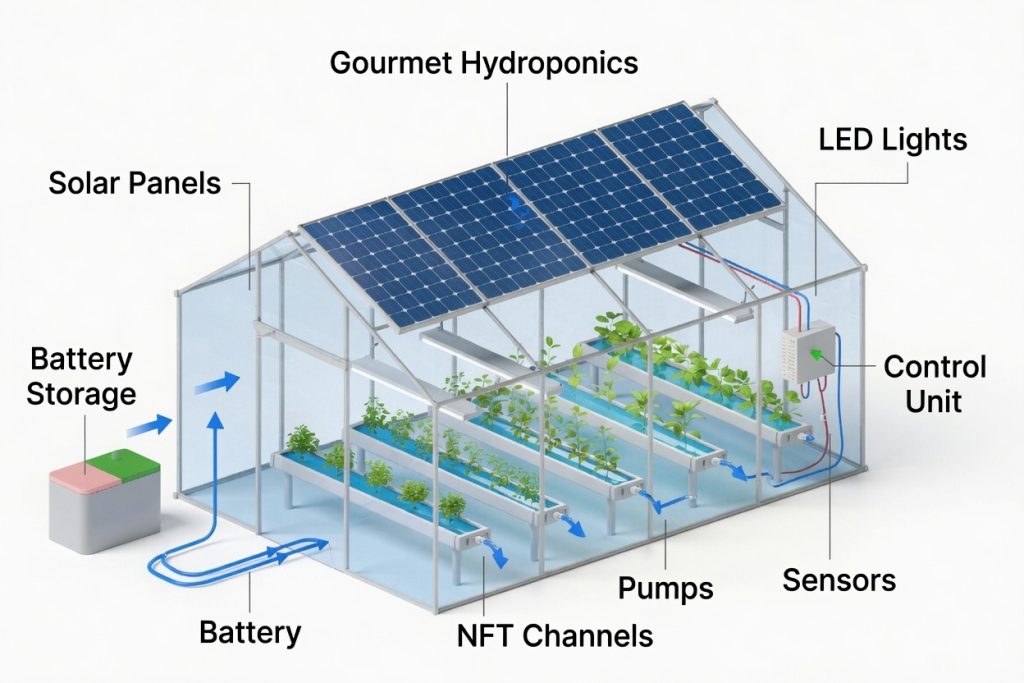
Solar PV for greenhouses and hydroponics converts sunlight into usable electricity for essential loads. High-efficiency monocrystalline panels, combined with inverters, MPPT charge controllers, and battery storage, deliver reliable power for 24/7 operation. Off-grid or hybrid configurations are ideal for small-scale needs, handling water pumps, ventilation fans, LED grow lights, sensors, and automation systems.
In solar greenhouses, roof-mounted or integrated semi-transparent PV panels generate electricity while regulating light and temperature. Semi-transparent solar cells (including organic and perovskite technologies) allow 20-30% or more light transmission, particularly in photosynthetically active radiation (PAR) wavelengths needed by crops. These panels produce meaningful power output while reducing excessive heat buildup, which lowers cooling and irrigation demands. Advances in wavelength-selective materials enable panels to filter non-essential light spectra for energy conversion without compromising plant growth.
Solar-powered hydroponics powers critical circulation in systems like Nutrient Film Technique (NFT), Deep Water Culture (DWC), or vertical towers. DC pumps move nutrient solutions efficiently, aerators maintain dissolved oxygen levels, and IoT devices monitor pH, EC, and environmental parameters in real time. Vertical hydroponic configurations can increase yields per square foot by up to 10 times compared to traditional soil methods, making them perfect for space-constrained small farms.
Key integration fundamentals include accurate system sizing based on local solar irradiance data and daily load calculations. Lithium-ion or advanced lead-acid batteries provide storage for nighttime and cloudy periods. Smart energy management systems prioritize loads and optimize consumption. Passive solar design elements—such as optimal orientation, thermal mass, and natural ventilation—complement active PV systems for maximum efficiency.
For small-scale applications, modular kits simplify deployment. Durable, weather-resistant panels withstand agricultural environments, including dust and humidity. Hybrid setups with optional grid or wind backup ensure uninterrupted operation. These fundamentals make solar hydroponic systems accessible even for beginners, turning sunlight into a stable power source for precise climate and nutrient control. Recent innovations in agrivoltaics further enhance dual-use potential, allowing simultaneous energy generation and crop cultivation.
Key Benefits and Performance Metrics
Integrating solar energy delivers compelling economic and environmental returns. Studies demonstrate electricity cost reductions of 40-66%. In a 2024 Indonesian project, a 800 WP solar array (four 200W panels) powered vertical hydroponic spinach production, cutting electricity consumption by 66%, lowering overall costs by around 10%, and increasing farm income by 15%—a significant boost for small operators facing unreliable grids.
Water efficiency stands out as a major advantage. Hydroponic systems with solar integration achieve 70-90% water savings versus soil-based farming through recirculation. A 2025 study on solar PV-powered NFT lettuce using treated greywater reported excellent water use efficiency of 0.073 kg/L, matching or exceeding grid-powered yields while maintaining superior quality.
Energy performance metrics are equally strong. The same study recorded an energy ratio of 0.11 (versus 0.05 for grid systems), energy productivity of 0.16 kg/MJ (versus 0.07), and specific energy consumption of 6.14 MJ/kg (versus 14.89 MJ/kg). CO₂ emissions dropped more than 94% (0.0861 kg CO₂ eq/m² versus 1.5386). Other research on PV-integrated systems showed carbon footprints as low as 1.6 kg CO₂-eq per kg of produce compared to 49.9 kg for grid-dependent alternatives.
Productivity gains come from year-round cultivation, precise environmental control, and protection from extremes. Vertical solar hydroponics multiplies output density dramatically. Payback periods typically range from 3-5 years with available incentives, sometimes shorter in high-irradiance regions, with additional revenue possible from excess energy export. Agrivoltaic approaches enable dual land use, further improving economics.
Broader benefits include enhanced resilience, reduced pesticide needs, urban food security, and local job creation. These metrics position solar-integrated systems as a high-ROI choice for small-scale solar energy applications in greenhouses and hydroponics.
Table 1: Performance Comparison – Solar-Powered Hydroponics vs. Conventional/Grid Systems
| Metric | Solar + Hydroponics (e.g., NFT Lettuce) | Conventional/Grid Hydroponics | Improvement |
|---|---|---|---|
| Energy Ratio | 0.11 | 0.05 | +120% |
| Energy Productivity | 0.16 kg/MJ | 0.07 kg/MJ | +129% |
| Specific Energy Consumption | 6.14 MJ/kg | 14.89 MJ/kg | -59% |
| CO₂ Emissions | 0.0861 kg CO₂ eq/m² | 1.5386 kg CO₂ eq/m² | >94% reduction |
| Water Use Efficiency | 0.073 kg/L | Higher consumption | 70-90% savings |
| Yield (Lettuce example) | 11.38 kg/m² | Comparable | Year-round consistency |
Integrated System Designs and Best Practices
Successful solar greenhouse designs blend passive solar principles (optimal south-facing orientation, thermal mass, high-insulation glazing) with active PV generation. Roof-mounted or semi-transparent panels provide both power and shading. Ground-mounted or wall-integrated arrays suit smaller or retrofitted structures. For hydroponics integration, systems range from simple DWC buckets and NFT channels to advanced vertical towers.
Solar hydroponic systems emphasize efficient DC components to match PV output directly, minimizing conversion losses. Key elements include variable-speed pumps, LED lighting tuned to crop needs and available solar power, automated nutrient dosing, and climate sensors. Hybrid configurations add grid or generator backup for maximum reliability.
Best practices for implementation:
- Perform thorough site assessment of solar irradiance, shading, and wind patterns.
- Calculate precise daily and peak loads, with pumps often being the largest consumer.
- Select MPPT controllers for optimal energy harvest.
- Incorporate robust battery storage sized for 1-3 days of autonomy.
- Deploy IoT automation for real-time monitoring and remote adjustments.
- Ensure regular maintenance: panel cleaning, battery checks, and system inspections.
- Begin with modular, scalable designs to test and expand gradually.
Innovations enhancing performance include wavelength-selective semi-transparent panels for greenhouses, AI-driven energy optimization, greywater recycling, and agrivoltaic dual-use systems. Challenges such as solar intermittency are mitigated through proper storage and load management. High initial costs can be addressed via financing, grants, or pay-as-you-save models. Technical expertise gaps are closing with user-friendly plug-and-play kits tailored for agriculture.
These designs make solar-powered greenhouses and hydroponics practical and profitable for small-scale producers worldwide.
Solar Greenhouse & Hydroponics Calculator
Calculate daily energy needs and estimate ROI for your solar-powered system
1. Daily Energy Consumption
Equipment Load
Real-World Case Studies and Examples
A 2025 Egyptian study on solar PV + treated greywater hydroponics (NFT lettuce) achieved yields of 11.38 kg/m²—matching conventional grid systems—while delivering >94% CO₂ reduction and superior resource efficiency.
In Indonesia (2024), a farmer group implemented 800 WP solar panels for vertical hydroponic spinach. Results included 66% lower electricity use, reduced operational costs, and a 15% profit increase despite frequent grid outages. The project combined training with practical solar-hydroponic deployment, demonstrating strong potential for energy-independent small farms.
Valldaura Labs' Solar Greenhouse in Barcelona showcases integrated success. The structure, built with locally sourced timber, uses hydroponics with sawdust substrate and rainwater recirculation. Solar panels power the system for year-round production, supplying food to the lab kitchen and a local restaurant. It serves as a prototype for urban self-sufficiency, with a larger version planned for a Barcelona skyscraper rooftop.
Other notable examples include solar desalination-integrated hydroponics in desert regions for reliable lettuce and fodder production, and passive-solar greenhouses in colder climates (e.g., North America) enabling winter harvests with minimal supplemental energy. A UAE hydroponic greenhouse case (2024) with solar supplementation harvested 630 tons of greens on 5,000 m², generating substantial revenue and achieving breakeven in under 28 months.
These cases illustrate scalability from backyard to small commercial operations, with consistent themes of cost savings, resilience, and sustainability in solar energy applications for small-scale food production.
Sunpal's Integrated Solutions for Growers
Sunpal offers high-efficiency solar modules, inverters, batteries, and mounting systems specifically optimized for agricultural environments. Modular kits are ideal for greenhouse roof integration or standalone solar-powered hydroponics power packs. Durable, high-performance panels handle dust, humidity, and variable weather common in farming.
Growers gain from customizable hybrid solutions with storage that ensure continuous operation of pumps, controls, and lighting. Sunpal's reliable components support both off-grid independence and grid-tied setups with export capability. Easy scalability allows starting small and expanding as needed.
These solutions help small operators achieve energy independence, significantly lower OPEX, and align with sustainability certifications or goals. Sunpal supports growers with tailored system design assistance for rapid, effective deployment in solar greenhouses and hydroponics.
A straightforward load audit is the first step toward implementation—Sunpal experts can guide selection of the right configuration for maximum ROI.
Table 2: Economic & Operational Benefits
| Benefit | Typical Results (Small-Scale) | Source Notes |
| Electricity Cost Reduction | 40–66% | 2024 Indonesian project |
| Overall Operating Cost Reduction | ~10% | Vertical hydroponics |
| Income Increase | +15% | Solar-powered spinach |
| Payback Period | 3–5 years (with incentives) | Industry averages |
| Water Savings | 70–90% vs. soil-based | Multiple studies |
Future Outlook and Recommendations
Falling panel and battery costs, rising efficiencies, and supportive policies (subsidies, carbon credits, net metering) are accelerating adoption. Next-generation semi-transparent agrivoltaics, IoT/AI optimization, and advanced energy storage will further improve performance and economics. Solar hydroponics and greenhouses will play a growing role in net-zero food systems, urban resilience, and climate adaptation.
Recommendations:
- Farmers: Start with a pilot system, conduct accurate load calculations, prioritize quality batteries, and pursue available incentives. Monitor performance data to optimize over time.
- Policymakers: Expand targeted support for small-scale agrivoltaics and renewable agriculture integration.
- Industry: Develop more turnkey kits, wavelength-selective panels, and financing models tailored to growers.
Alignment with UN SDGs—zero hunger, affordable clean energy, and climate action—underscores the broader importance of these technologies.
Conclusion
Solar energy is transforming small-scale food production by powering efficient greenhouses and hydroponics with clean, abundant sunlight. Dramatic reductions in costs and water use, combined with higher yields and greater resilience, create compelling economic and environmental advantages. Proven real-world examples and advancing technologies demonstrate that integrated solutions are practical and profitable today. Sunpal stands ready to support growers with reliable, tailored solar systems. The future belongs to small producers empowered to build sustainable, self-sufficient operations harnessed directly from the sun.