


Introduction
Australian mining giant Fortescue Metals Group is fast-tracking what it calls the world's largest off-grid system for heavy industry. The project in Western Australia's Pilbara region features 1.2 GW of solar capacity, over 600 MW of wind, and a massive 4–5 GWh battery energy storage system (BESS). This integrated renewable and storage hub aims to deliver reliable, around-the-clock power to iron ore operations while slashing diesel use and accelerating the company's Real Zero decarbonization goals, with full operations targeted for 2028.
In remote, high-demand industrial settings, the battery system serves as the critical “Stabilizer” — balancing renewable intermittency, ensuring grid stability, and enabling continuous operations without heavy reliance on fossil fuels. Among available technologies, LiFePO4 (LFP) batteries stand out as the premier choice for industrial-grade energy storage in off-grid microgrids and large-scale solar-plus-storage projects.
This article examines why LiFePO4 chemistry dominates GWh-scale deployments, its advantages for mining and heavy industry energy transformation, and key lessons from landmark projects like Fortescue's.
The Rise of GWh-Scale Off-Grid Microgrids in Heavy Industry
Heavy industries, especially mining, operate in some of the most energy-intensive and logistically challenging environments on Earth. Remote mine sites often rely on diesel generators that are expensive to fuel, maintain, and supply. With global pressure to reduce Scope 1 and 2 emissions, volatile fuel prices, and corporate net-zero commitments, many operators are turning to hybrid renewable microgrids supported by utility-scale battery storage.
Fortescue's Pilbara project stands as a flagship example. The initiative combines 1.2 GW solar, more than 600 MW wind generation, and 4–5 GWh of BESS to create a fully islanded high-voltage renewable network dedicated to powering iron ore mining and processing. Early milestones include the deployment of a 50 MW / 250 MWh BYD LFP-based system at North Star Junction in late 2025, with additional capacity planned at sites like Eliwana. The project aims to enable daytime green processing by early 2027 and full 24-hour fossil-free operations shortly thereafter.
This is not an isolated case. Across Australia, Africa, South America, and other resource-rich regions, mining companies are actively planning or implementing large off-grid and microgrid solutions. Market analysts project strong growth in the commercial and industrial (C&I) BESS segment, driven by applications in mining, data centers, and heavy manufacturing. GWh-scale projects are becoming more common as costs decline and technology maturity increases.
Core Challenges Addressed by Large Storage
Off-grid microgrids must handle highly variable renewable generation against relatively steady but fluctuating industrial loads (e.g., crushers, conveyors, pumps, and processing plants). Without sufficient storage, operators risk curtailment, instability, or continued diesel dependence. A properly sized BESS acts as the system stabilizer — providing energy shifting, frequency regulation, voltage support, and black-start capability.
Environmental factors add complexity: extreme heat, dust, vibration, and temperature swings common in mining regions demand rugged, reliable solutions. Phased deployment is also essential, allowing projects to match capital expenditure with mine development schedules and operational needs.
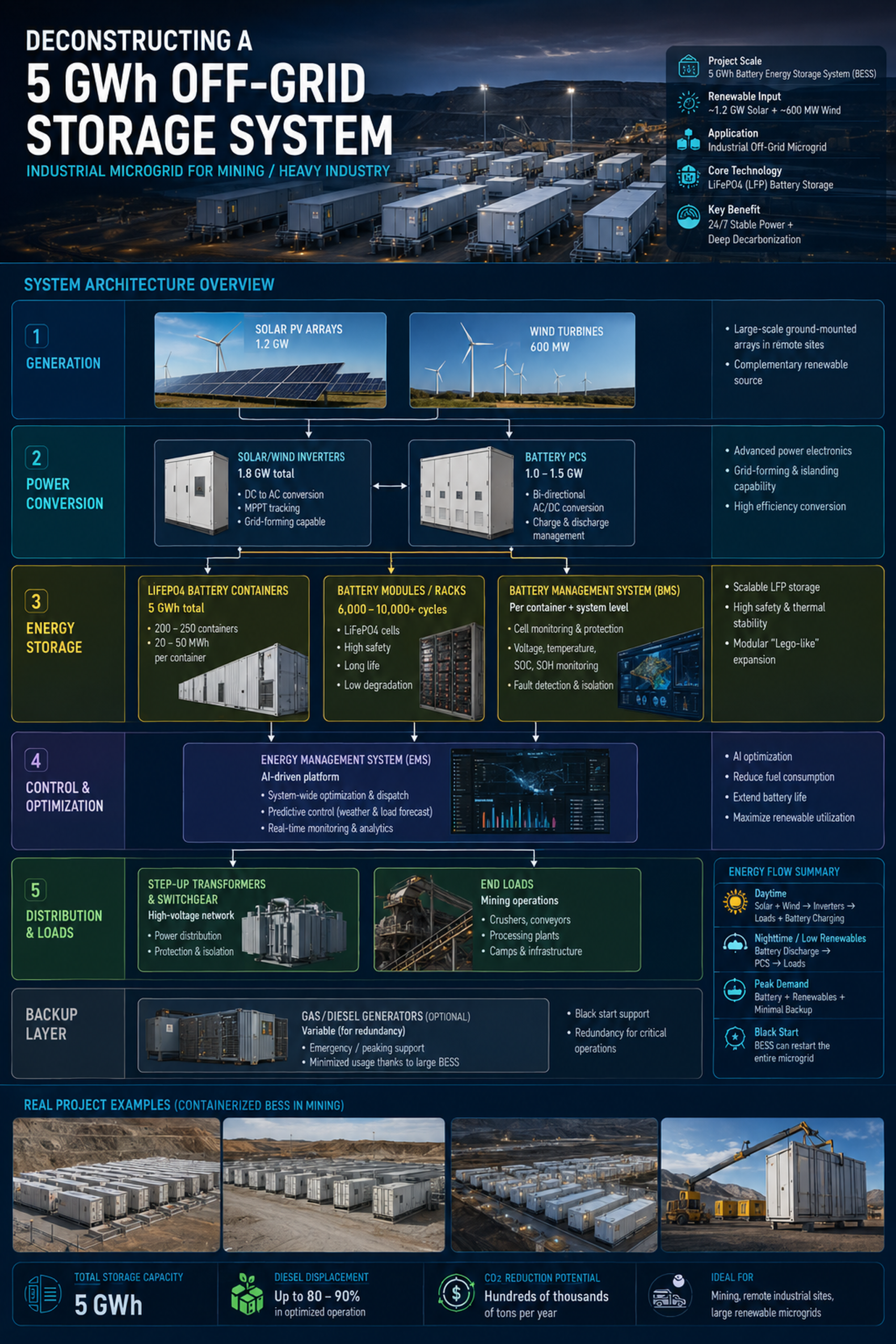
Deconstructing a 5 GWh Off-Grid Storage System
1.2 GW Solar + 600 MW Wind + 5 GWh LFP Storage for Industrial Microgrids
These trends signal a broader industry shift: large-scale solar + storage systems are no longer experimental but are becoming the standard pathway for sustainable and cost-effective industrial energy supply.
Why LiFePO4 Batteries Excel as the Industrial Stabilizer
LiFePO4 (Lithium Iron Phosphate) technology has established itself as the dominant chemistry for stationary industrial-grade energy storage, particularly in demanding off-grid microgrid and GWh-scale applications. Its technical and economic profile aligns exceptionally well with the requirements of continuous heavy industrial operations.
Superior Safety Profile
Safety is paramount in remote industrial sites where firefighting resources are limited. LFP chemistry exhibits outstanding thermal and chemical stability. It has a much higher thermal runaway threshold than nickel-manganese-cobalt (NMC) or nickel-cobalt-aluminum (NCA) chemistries. Even under abuse conditions such as overcharge, short circuit, or physical damage, LFP cells are far less prone to fire or explosion. This inherent safety simplifies system design (reduced fire suppression needs), eases regulatory approvals, and lowers insurance costs for large installations.
Exceptional Cycle Life and Longevity
LFP batteries routinely achieve 6,000–10,000+ cycles at 80% depth of discharge with minimal capacity fade. In real-world stationary applications, well-managed systems often deliver 10–15 years or more of service life. This longevity is especially valuable in industrial settings where daily cycling is common. Over the project lifetime, the higher upfront investment is offset by dramatically lower replacement frequency and maintenance costs compared to shorter-life alternatives.
Scalability for GWh Projects
Modular containerized LFP designs allow projects to start at MW/MWh scale and expand seamlessly to multi-GWh capacity. This flexibility supports Fortescue-style phased rollouts without major system redesigns. Batteries can be added in standardized containers, minimizing civil works and integration complexity.
Robust Environmental Performance
Mining and remote sites often experience temperature extremes. With appropriate thermal management, LFP systems operate reliably across wide ranges. They also tolerate high vibration and dust levels better than many alternatives when properly enclosed. High round-trip efficiency (typically 92–96%) maximizes the usable energy from renewable sources.
Strong Economic Case at Industrial Scale
Although LFP has slightly lower energy density than NMC, stationary applications prioritize cost per kWh, cycle life, and safety over weight or space. LFP delivers one of the lowest levelized costs of storage (LCOS) for long-duration, high-throughput uses. As battery prices continue to fall, the economics for diesel displacement in mining become highly attractive — often with payback periods of just a few years through fuel savings alone.
Comparison of Battery Chemistries for Industrial Off-Grid Use
| Feature | LiFePO4 (LFP) | NMC/NCA | Lead-Acid |
| Cycle Life (80% DoD) | 6,000–10,000+ | 2,000–6,000 | 500–1,500 |
| Safety (Thermal Runaway) | Excellent | Moderate | Good |
| Lifespan (Years) | 10–15+ | 7–10 | 3–5 |
| TCO at GWh Scale | Low | Medium | High |
| Temperature Tolerance | High | Moderate | Lower |
| Best For | Stationary Industrial | High-density mobile | Low-cycle backup |
Additional real-world data reinforces these advantages. Field studies of LFP systems in commercial and industrial settings show annual capacity fade below 0.5% in many cases, with round-trip efficiency averaging around 96%. In microgrid applications, LFP batteries have demonstrated the ability to support critical loads for extended periods during outages while maintaining grid-forming stability.
For heavy industry, these attributes translate directly into operational benefits: more predictable energy costs, reduced exposure to fuel price volatility, lower carbon footprint, and enhanced energy security. When paired with solar PV in off-grid configurations, LFP storage maximizes self-consumption and minimizes curtailment, delivering clean, dispatchable power exactly when mining operations need it most.
System Architecture: Building a Reliable GWh-Scale Off-Grid Solution
Designing a GWh-scale off-grid microgrid requires a tightly integrated architecture where the BESS serves as the central stabilizer.
Core Components
- Renewable Generation Layer: Solar PV arrays and wind turbines provide the primary energy source.
- Energy Storage Layer: Thousands of LiFePO4 cells grouped into modules, racks, and containerized units. Advanced BMS monitors every cell for voltage, temperature, and state of health.
- Power Electronics: High-efficiency bidirectional PCS/inverters handle conversion and provide grid-forming functionality.
- Energy Management System (EMS): Sophisticated software with AI-driven predictive algorithms optimizes dispatch based on weather forecasts, load profiles, and operational priorities.
- Balance of System: Switchgear, transformers, cooling, fire suppression, and monitoring platforms.
In practice, the system must support multiple operating modes: renewable-following, peak shaving, diesel minimization, frequency regulation, and full islanded operation. Black-start capability is essential for recovery after total shutdowns.
Integration Best Practices
Modern containerized LFP systems are designed for plug-and-play integration with various inverters and existing generation assets. This is particularly valuable in brownfield mining sites that already have gas or diesel infrastructure. Thermal management systems (liquid or air cooling) maintain optimal battery temperature even in hot climates like the Pilbara.
Phased Deployment Strategy
Successful GWh projects rarely deploy all capacity at once. Instead, they follow a modular roadmap: initial pilot or Phase 1 systems prove the concept and deliver early savings, then subsequent phases scale capacity as confidence and demand grow. This approach de-risks financing and allows operators to learn from real performance data.
Real-World Impact and Project Considerations
Fortescue's project illustrates the transformative potential: projected annual diesel savings in the hundreds of millions of dollars, major emissions reductions, and improved energy price stability. Similar benefits are being realized in other mining operations adopting hybrid systems.
Key Project Planning Factors
- Accurate load profiling and renewable resource assessment.
- Comprehensive techno-economic modeling (including sensitivity analysis for fuel prices and battery costs).
- Supplier evaluation focusing on warranty terms, integration track record, and long-term support.
- Environmental hardening and safety compliance.
- Grid code and regulatory requirements for islanded systems.
Risk mitigation includes redundancy, conservative sizing, and performance guarantees. Choosing LFP technology significantly reduces safety-related risks.
Future Outlook: The GWh Era of Industrial Energy Storage
The global BESS market is experiencing rapid expansion, with annual installations exceeding 300 GWh in recent years and forecasts pointing even higher. In the mining and heavy industry segment, hybrid renewable microgrids are transitioning from niche to mainstream solutions.
Technological advancements — such as improved LFP cell densities, next-generation BMS with AI optimization, and better hybrid integration with hydrogen or other storage — will further enhance performance. Policy drivers, carbon pricing, and corporate sustainability mandates will continue to accelerate adoption worldwide.
The Fortescue project and others like it are setting new benchmarks and proving that deep decarbonization of heavy industry is both technically feasible and economically viable.
Conclusion
Fortescue's landmark off-grid initiative highlights a fundamental industry truth: LiFePO4 batteries are the most effective stabilizer for reliable, sustainable industrial microgrids. Their unmatched combination of safety, cycle life, scalability, and economics makes them the ideal technology for GWh-scale solar-plus-storage deployments in mining and heavy industry.
For companies planning large off-grid microgrids or industrial energy transformation projects, partnering with experienced solution providers is essential. Sunpal delivers robust, modular LiFePO4 containerized energy storage systems specifically engineered for these high-demand applications.Take the next step today. Contact Sunpal's engineering team for a customized feasibility assessment, system design support, and detailed quotation for your project.