


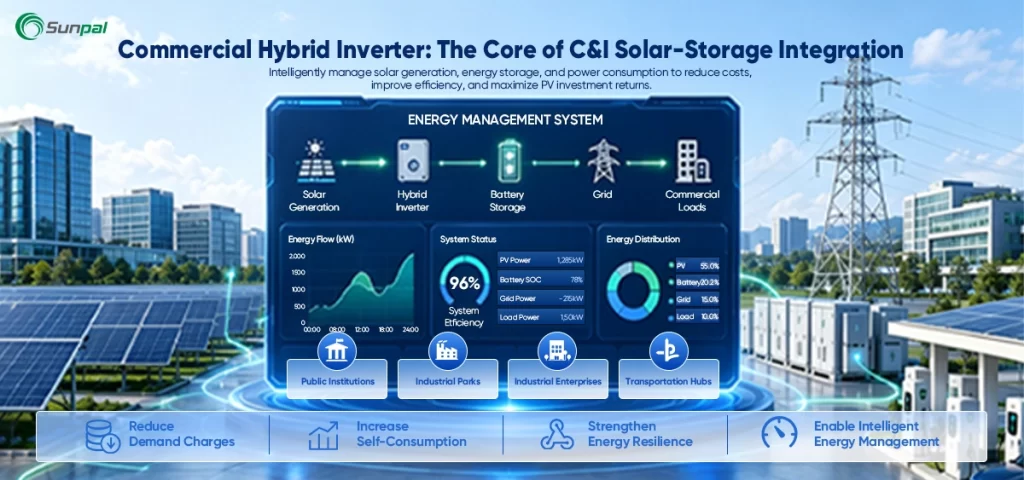
Commercial hybrid inverters are evolving from power conversion devices into intelligent energy management platforms, creating more advanced B2B solar inverter solutions for commercial and industrial applications. As businesses face rising electricity costs, wider time-of-use (TOU) price gaps, demand charges, and increasing grid reliability concerns, solar-plus-storage is becoming a strategic tool for managing energy—not simply generating it.
By bringing solar generation, battery storage, and grid interaction together, hybrid inverters enable commercial facilities to use energy more strategically. This creates new opportunities to reduce electricity costs, improve energy resilience, and increase the overall value of solar-plus-storage investments.
This evolution is reshaping the business case for commercial solar solutions, with the focus shifting from how much energy a system can generate to how effectively it can manage energy.
Lower Total System Cost and Improve Project Economics
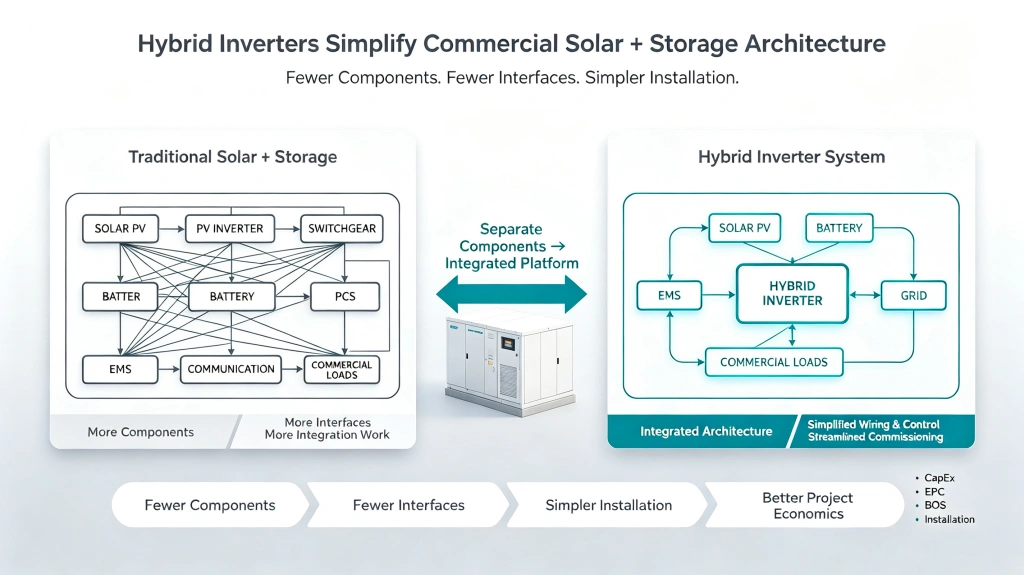
The business case for commercial hybrid inverters starts with system-level cost optimization. By integrating power conversion, battery management, and energy control functions into a more coordinated platform, hybrid inverters can simplify the architecture of commercial solar-plus-storage systems and reduce system integration and installation costs.
Optimize CapEx Through System Integration
Traditional commercial solar-plus-storage projects may require separate PV inverters, battery PCS, EMS equipment, communication interfaces, switchgear, and control components. A hybrid inverter can integrate multiple functions into a unified platform, reducing the number of standalone devices and system interfaces.
This can help optimize overall project CapEx, simplify procurement, and reduce engineering complexity.
Lower Installation and EPC Costs
System integration can also reduce the amount of wiring, electrical connections, communication interfaces, and control integration required during installation. For installers and EPC contractors, fewer integration points can translate into simpler installation, faster commissioning, and lower labor requirements.
The benefits can extend to balance-of-system (BOS) costs, including electrical protection, communication equipment, cabling, and other supporting components. By reducing unnecessary equipment and simplifying system architecture, hybrid inverters can help improve overall project economics beyond the inverter's purchase price.
Why It Matters for Commercial Projects
For C&I projects, the relevant metric is not simply the inverter's unit price but the total installed system cost.
A more integrated architecture can potentially reduce:
- System integration complexity
- Equipment and procurement costs
- Engineering and design effort
- Electrical and communication components
- Installation labor
- Commissioning time
As a result, commercial hybrid inverters can contribute to a lower total cost of ownership (TCO) and improve the financial attractiveness of solar-plus-storage projects.
Peak Shaving and Energy Arbitrage: Turning Batteries into Financial Assets
For commercial electricity users, a battery is more than a backup power source. When intelligently controlled by a hybrid inverter, it becomes an active energy asset that can respond to facility demand, electricity prices, and solar generation conditions. This creates opportunities to reduce demand charges, optimize energy consumption, and lower overall electricity costs.
Peak Shaving: Reducing Demand Charges
Commercial electricity bills often include demand charges based on the facility's highest power demand during a billing period. Short periods of high consumption—such as equipment startup, production peaks, or simultaneous operation of multiple loads—can therefore have a significant impact on monthly electricity costs.
A hybrid inverter can respond to these demand spikes by coordinating battery discharge and solar generation to reduce the amount of power drawn from the grid.
By keeping grid demand below targeted thresholds, businesses can potentially reduce demand-related charges while making better use of their on-site energy resources.
TOU Arbitrage: Charging Low, Discharging High
Time-of-use (TOU) electricity pricing creates another opportunity for commercial energy savings.
The hybrid inverter can charge the battery when electricity prices are lower or when excess solar generation is available, then discharge stored energy during higher-priced periods.
This allows businesses to shift energy consumption away from expensive tariff periods and increase the economic value of stored solar power.
Intelligent Battery Dispatch
The effectiveness of peak shaving and energy arbitrage depends on when and how the battery is dispatched. A commercial hybrid inverter can coordinate battery charging and discharging according to solar production, facility load, battery state of charge, and electricity pricing.
Instead of treating the battery as a passive backup device, the system continuously manages it as a flexible energy resource.
The operating model therefore evolves from:
Generate → Consume
to:
Generate → Store → Dispatch → Optimize
By combining peak demand management, TOU arbitrage, and intelligent battery dispatch, commercial hybrid inverters can reduce both the amount and cost of electricity purchased from the grid. The result is a shift from simply generating more solar power to using energy at the right time and at the lowest practical cost.
AI-Powered Energy Management
The next evolution of commercial hybrid inverters is the integration of AI-assisted energy management, energy management systems (EMS), and predictive analytics.
Instead of relying solely on fixed charging and discharging schedules, AI-enabled systems can evaluate multiple variables, including:
- Historical facility load
- Real-time electricity prices
- Weather and solar forecasts
- Battery state of charge
- Production schedules
- Grid conditions
This creates a three-stage operating logic:
Forecast → Optimize → Dispatch
The system forecasts upcoming solar generation and energy demand, determines the most economical operating strategy, and dynamically adjusts battery charging, discharging, and energy allocation.
For example, if high facility demand is expected while poor weather may reduce solar generation, the system can preserve battery capacity in advance and prioritize stored energy for higher-value periods.
This moves commercial energy storage from rule-based control to predictive energy optimization, helping improve battery utilization and maximize the economic value of solar-plus-storage assets.
Predictive Maintenance and Intelligent O&M
AI can also improve how commercial energy assets are monitored and maintained.
Rather than waiting for equipment faults or relying entirely on fixed maintenance schedules, AI-assisted monitoring can continuously evaluate inverter, battery, and electrical performance to identify abnormal patterns and potential issues at an early stage.
Key applications include:
- Early detection of inverter and battery anomalies
- Performance and fault monitoring
- Remote diagnostics
- Predictive maintenance alerts
- Condition-based O&M
This shifts maintenance from reactive service to proactive asset management. Earlier detection can help reduce unplanned downtime, avoid unnecessary maintenance visits, and improve long-term system availability.
For commercial projects, this matters because less downtime means more time available for energy generation, storage, and productive operation. Higher system availability can therefore directly support energy yield, operating continuity, and project economics.
The AI Value Chain
Together, these capabilities form a broader AI value chain:
Forecast → Optimize → Predict
- Forecast: Anticipate solar generation, load demand, and grid conditions.
- Optimize: Dynamically allocate PV, battery, and grid energy.
- Predict: Identify equipment anomalies before they become major failures.
This enables commercial hybrid inverters to evolve from conventional power conversion equipment into intelligent energy management platforms that optimize both energy performance and asset reliability.
Backup, Microgrid and Energy Resilience
Energy cost savings are only part of the commercial value proposition. For data centers, manufacturing facilities, warehouses, refrigeration systems, telecommunications infrastructure, and other critical operations, power interruptions can create losses far beyond the cost of electricity itself.
When integrated with compatible batteries, switchgear, protection equipment, and control systems, commercial hybrid inverters can provide backup power during grid outages. The system can prioritize critical loads and use available solar generation and stored energy to maintain essential operations.
With appropriate islanding and grid-forming capabilities, the system can disconnect from the utility grid and continue operating independently. When combined with solar PV, battery storage, and intelligent controls, this architecture can form the foundation of a commercial microgrid, allowing facilities to manage available energy and prioritize critical loads during extended outages.
This creates a clear progression:
Backup → Islanding → Microgrid → Resilience
The value therefore extends beyond emergency backup. By combining local generation, energy storage, and intelligent controls, commercial hybrid systems can improve energy independence, operational continuity, and resilience against grid disruptions.
For businesses where even short outages can interrupt production, refrigeration, data processing, or other critical services, this resilience can help reduce the operational and financial impact of downtime. Battery storage therefore becomes not only an energy-saving asset, but also a strategic resilience asset for business continuity. asset that supports both energy management and business continuity.
VPP: Creating New Revenue from Distributed Energy Assets
Another emerging opportunity is the integration of commercial solar-plus-storage systems into Virtual Power Plants (VPPs).
Instead of operating each battery as an isolated asset, connected systems can be aggregated through cloud-based platforms and coordinated as distributed energy resources.
Depending on local electricity market rules and program requirements, participating assets may support:
- Demand response
- Grid balancing
- Capacity services
- Energy market participation
- Other distributed energy programs
This creates a new layer of value for commercial energy assets.
A battery can potentially reduce electricity costs behind the meter while also participating in grid-support programs, when market conditions and regulations allow.
However, VPP participation remains highly market-dependent. Program availability, compensation mechanisms, interconnection requirements, and aggregator rules vary by region. For commercial solar-plus-storage developers, VPP integration therefore represents a potential future revenue opportunity rather than a guaranteed source of income.
Commercial Hybrid Inverters vs. Conventional Grid-Tied Inverters
The difference between the two architectures becomes clearer when viewed from a long-term business perspective:
| Evaluation Dimension | Conventional Grid-Tied Inverter | Commercial Hybrid Inverter |
|---|---|---|
| Primary Function | Solar power conversion | Solar, storage, grid, and load coordination |
| Initial Equipment Cost | Generally lower | Generally higher due to additional functionality |
| Energy Storage | Requires additional equipment or AC coupling | Integrated battery interface/control |
| Écrêtement des pointes | Limitée | Supported with battery integration |
| Energy Arbitrage | Not available independently | Supported |
| Alimentation de secours | Typically unavailable | Available with compatible system architecture |
| Microgrid Capability | Limitée | Supported by advanced systems |
| AI Energy Optimization | Limitée | Increasingly available |
| Future Expansion | May require additional equipment | More flexible for storage and energy-management expansion |
| Potential Revenue Streams | Primarily solar energy savings | Savings + resilience + potential grid services |
The conventional inverter remains an effective solution for projects focused primarily on daytime solar generation.
However, for businesses facing high demand charges, time-of-use tariffs, unreliable grids, or growing energy-management requirements, the additional functionality of a hybrid system can create greater long-term value.
2026: A More Complex Policy and Market Environment
The business case for commercial solar-plus-storage in 2026 is being shaped by both evolving energy markets and a changing policy environment.
In the United States, the Section 48E Clean Electricity Investment Credit applies to qualifying clean electricity facilities and energy storage technology placed in service after December 31, 2024. The credit has a 6% base rate and can increase to 30% when applicable prevailing-wage and apprenticeship requirements are satisfied, with additional bonuses potentially available for qualifying projects.
At the same time, commercial developers need to consider project eligibility, equipment sourcing, labor requirements, domestic-content considerations, electricity tariffs, and system configuration when evaluating project economics. The 2026 opportunity is therefore not simply about tax incentives—it is about designing a solar-plus-storage system that can deliver value through energy savings, demand management, resilience, and intelligent energy optimization.
What This Means for B2B Solar Buyers
For commercial energy buyers, EPC contractors, installers, and project developers, selecting the right B2B solar suppliers and hybrid inverter solutions should go beyond comparing inverter price and rated power.
Key evaluation criteria should include:
System Integration
Can the inverter coordinate PV, batteries, grid power, and facility loads through a unified architecture?
Gestion de l'énergie
Does the system support peak shaving, time-of-use optimization, zero-export control, and dynamic energy dispatch?
Backup and Microgrid Capability
Can the system support critical loads during grid outages, and does it provide the required grid-forming or islanding functions?
Battery Compatibility
Does the inverter support the required battery voltage range, communication protocols, BMS integration, and future storage expansion?
Intelligent Monitoring
Can operators remotely monitor performance, receive alarms, analyze historical data, and implement predictive maintenance strategies?
Évolutivité
Can the system expand as the facility adds solar capacity, storage, EV charging, or other distributed energy resources?
From Energy Savings to Intelligent Energy Management
For C&I businesses, the value of hybrid inverters extends beyond solar generation and battery backup. By combining cost optimization, demand management, resilience, intelligent control, and future grid participation, hybrid systems provide a more flexible foundation for commercial energy strategies.
Sunpal provides integrated solar-plus-storage solutions that combine PV, onduleurs hybrides, batteries, and intelligent energy management to help commercial customers and B2B partners build efficient, future-ready energy systems.
The future of commercial solar is not just generating more energy—it is using energy smarter.