


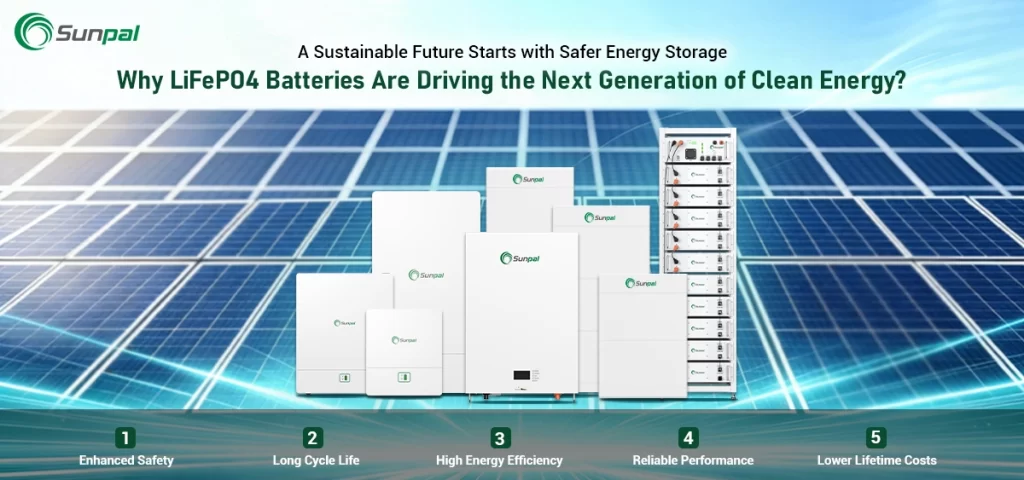
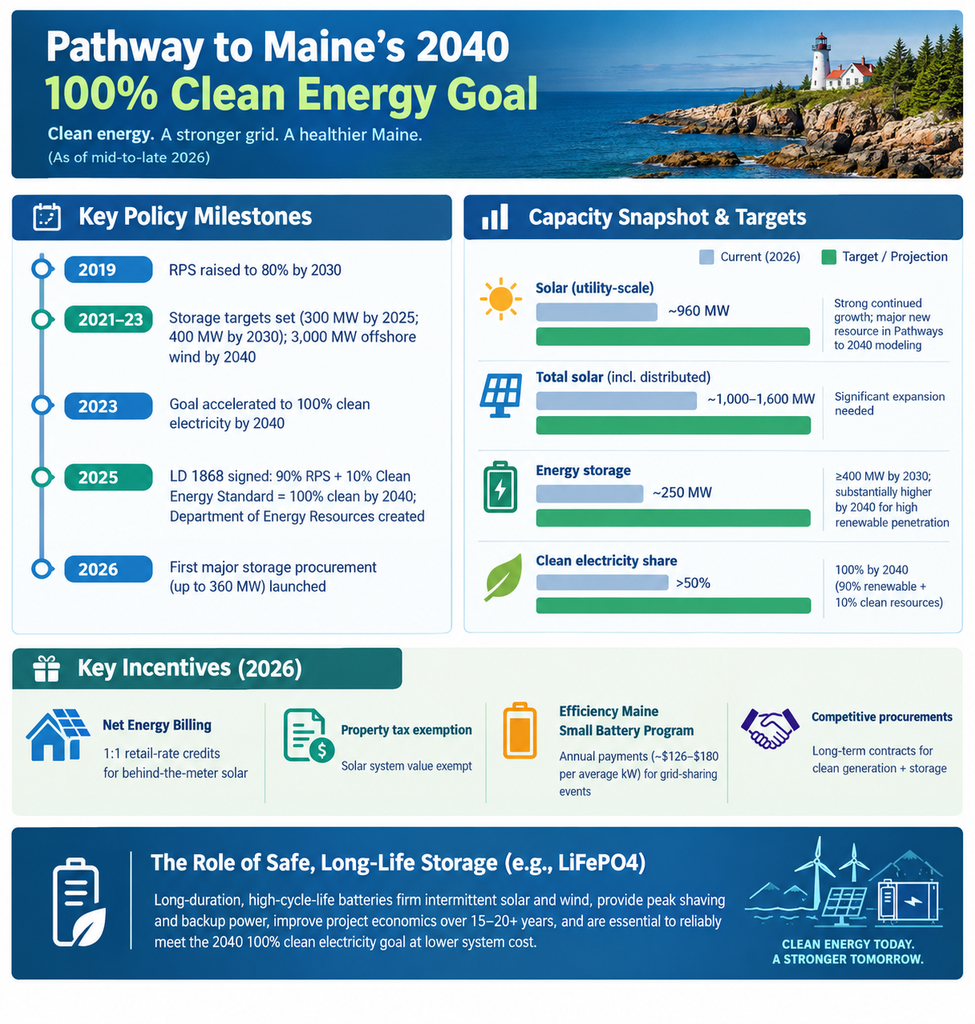
When Maine Governor Janet Mills received the “Clean Energy Leader” award from the Maine Renewable Energy Association, it marked more than a personal honor. It spotlighted a state racing toward a bold target: 100% renewable electricity by 2040. Solar arrays are rising across rooftops and fields, wind turbines spin along the coast, and communities are talking seriously about energy independence. Yet one quiet truth sits at the heart of this ambition: without the right energy storage, those renewable electrons remain intermittent, fragile, and incomplete.
A sustainable energy future is not built on generation alone. It depends on storage that is safe enough for homes and businesses, durable enough to outlast policy cycles, and economical enough to deliver real returns. That is why safe, long-life LiFePO4 energy storage has become indispensable. It is the technology that turns ambitious renewable goals into reliable, everyday power.
From Policy Ambition to Practical Reality: Maine's Clean Energy Moment
Maine's story is instructive for any state or region chasing high renewable penetration. Under Governor Mills, the state has advanced legislation, strengthened renewable portfolio standards, and actively supported solar, wind, and storage development. The result is accelerating project pipelines, new jobs, and growing investment. The 2040 target is not aspirational theater—it is written into policy and backed by incentives that make solar plus storage increasingly attractive for both residential and commercial customers.
Similar dynamics are playing out across the Northeast and beyond. States with aggressive clean-energy mandates create sustained demand for solutions that can firm intermittent solar and wind, manage evening peaks, and provide backup when the grid is stressed. For installers, developers, and homeowners evaluating battery storage for Maine homes and businesses, the question is no longer whether storage is needed. The question is which chemistry can deliver safety, longevity, and value over the multi-decade horizon that policy targets demand.
What “Sustainable” Really Means for Energy Storage
Sustainability in energy storage rests on three pillars: environmental responsibility, economic durability, and operational safety. A battery that requires frequent replacement, carries elevated fire risk, or relies on constrained critical minerals ultimately undermines the very goals it is meant to support.
Traditional high-energy-density lithium-ion chemistries such as NMC have powered the early wave of electric vehicles and some stationary systems. They pack more energy per kilogram, but they come with trade-offs: higher thermal runaway risk, shorter cycle life under deep daily cycling, and greater dependence on cobalt and nickel. In contrast, lithium iron phosphate—LiFePO4—offers a fundamentally different profile. Its olivine crystal structure is inherently more stable. It does not contain cobalt. It tolerates high temperatures better and resists thermal runaway far more effectively.
These characteristics matter intensely in real-world installations. Residential systems sit in garages or utility rooms. Commercial solar projects Maine developers are building often place batteries near occupied buildings or critical loads. Community resilience hubs need storage that will not become a liability during a storm. Safety is not a marketing bullet; it is a prerequisite for permitting, insurance, and public acceptance.
LiFePO4 (LFP) vs NMC Battery Comparison
Key performance indicators for stationary energy storage, covering thermal stability, cycle life, calendar life and relative lifetime storage cost.
1. Thermal Runaway Onset Temperature
Higher onset temperature generally indicates better thermal stabilityRepresentative reported values only. Test methods, cell design and failure conditions affect thermal runaway onset.
2. Cycle Life
Representative mid-range valuesIllustrative comparison using the supplied mid-range values. Cycle life depends on DoD, temperature, C-rate and end-of-life criteria.
3. Calendar Life
Typical estimated service-life rangeBars use illustrative midpoint values of 20 years for LFP and 12.5 years for NMC. They are not warranty guarantees.
4. Levelized Cost of Storage (LCOS)
Relative lifetime cost comparisonLiFePO4 (LFP)
Lower
Longer cycle life can reduce replacement frequency and lifetime cost in frequent-cycling applications.
NMC
Potentially Higher
Shorter cycle life under some operating conditions can increase replacement-related costs.
No absolute LCOS values are plotted because a fair comparison requires consistent assumptions for CAPEX, efficiency, financing, cycling, degradation and replacement costs.
Why LFP Is Widely Used in Stationary Energy Storage
LiFePO4 combines comparatively strong thermal stability, long cycle life and potential lifetime cost advantages. These characteristics make it a common choice for commercial and industrial BESS and utility-scale storage. Final chemistry selection should reflect project economics, operating requirements and system-level safety design.
Data note: Representative industry ranges supplied for comparison, not universal specifications or independently verified values for every cell. Values are typically reported under specified test conditions (often around 25°C). Actual performance depends on cell grade, temperature, C-rate, DoD, battery management, thermal management and system design. Thermal runaway onset temperature alone does not determine overall battery system safety.
The Longevity Advantage That Matches Policy Timeframes
Policy targets such as Maine's 100% renewable energy goal stretch across decades. Systems installed in the mid-2020s must still perform reliably in the 2040s. That is where cycle life and calendar life become decisive.
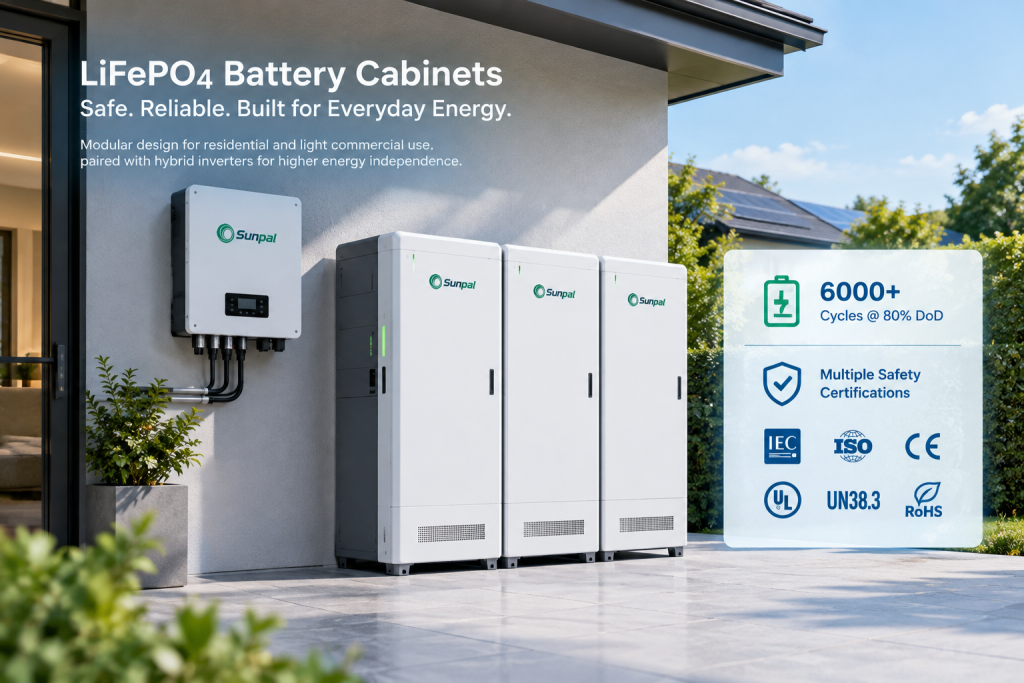
Quality LiFePO4 batteries routinely deliver 6,000 cycles or more at high depth of discharge while retaining strong capacity. Many manufacturers now publish warranties of 10–15 years with performance guarantees that align with the economic life of solar arrays. When a battery can cycle daily for 15–20 years, the levelized cost of storage drops significantly. Project returns improve. Replacement risk shrinks. Financing becomes easier because lenders and investors see a more predictable asset.
For solar companies and customers evaluating solar plus storage solutions for states with aggressive renewable portfolio standards, this longevity is transformative. A system that degrades slowly continues to shift solar production into evening hours, reduce demand charges, and provide backup power year after year. The economics compound. The environmental benefit compounds. The contribution to grid stability compounds.
Safety as the Foundation of Scale
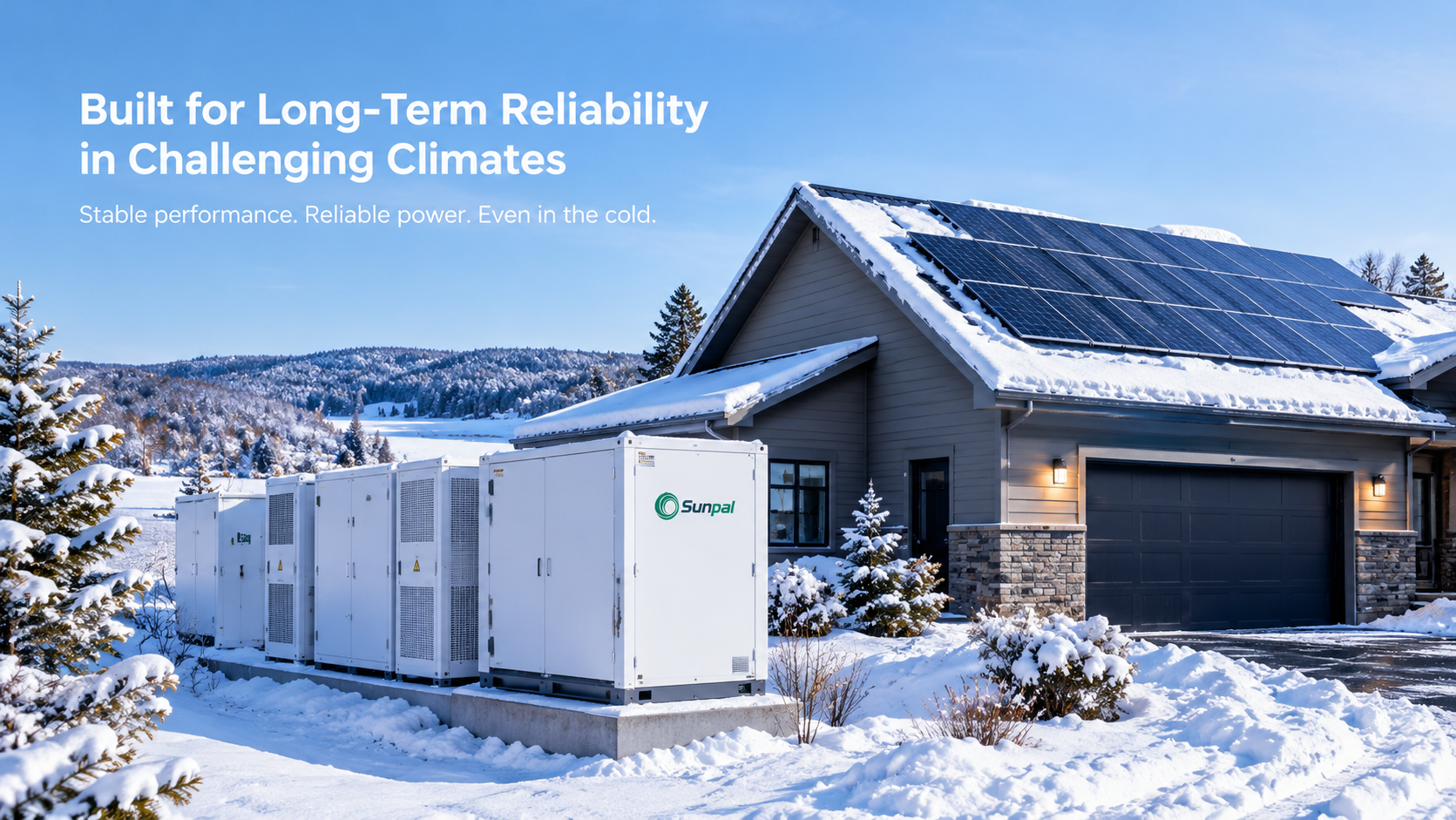
No storage technology scales if communities, insurers, and code officials do not trust it. LiFePO4's superior thermal and chemical stability has made it the preferred chemistry for stationary storage worldwide. In the event of abuse—overcharge, external heat, or physical damage—LiFePO4 is far less likely to enter thermal runaway. Many systems can even pass rigorous safety tests that higher-energy chemistries struggle with.
This safety margin translates into practical advantages. Installers face fewer barriers during permitting. Insurance premiums are often more favorable. Building owners and homeowners gain peace of mind. For Maine energy storage installers and commercial project developers, these factors accelerate timelines and reduce soft costs—critical when trying to capture limited incentive windows or meet interconnection deadlines.
Grid-independent power solutions and hybrid systems that combine solar with LiFePO4 storage further enhance resilience. During outages, the battery can island cleanly and power essential loads without the fire-risk concerns that can complicate emergency response. In regions experiencing more frequent extreme weather, this reliability is not optional.
Why LiFePO4 Is the Safe Choice for Homes and Businesses
Battery chemistry matters. Learn how lithium iron phosphate compares with NMC, explore thermal stability testing, and see battery storage applications for residential and commercial use.
LiFePO4 Battery Safety Testing
Examine battery response under a physical abuse test. A single test does not establish the safety of every battery cell or complete storage system.
Open video on YouTube →Understanding Thermal Runaway
See battery-cell testing footage and learn why thermal management, electrical protection, and system design matter. Verify the tested cell chemistry before making comparisons.
Open video on YouTube →Energy Storage for Homes
Explore a residential solar-and-battery installation, including the role of battery storage in a home energy system.
Open video on YouTube →Battery Storage for Businesses
Explore a commercial and industrial battery storage installation and its role in business energy management.
Open video on YouTube →LFP vs NMC: Two Different Cathode Structures
These original animated diagrams illustrate the general structural differences between LFP and NMC cathode materials. They are conceptual visuals, not atomic-scale simulations.
LiFePO4 / Olivine Structure
LFP has an olivine-type structure with a phosphate-based framework. It generally offers greater thermal stability than conventional NMC cathode chemistries.
NMC / Layered Oxide Structure
NMC uses a layered transition-metal oxide structure. Its thermal response varies with composition, cell design, state of charge, and operating conditions.
Choose Storage with Safety in Mind
Explore LiFePO4 energy storage solutions for residential, commercial, and industrial applications.
EXPLORE SUNPAL ESS SOLUTIONSThe crystal diagrams are conceptual, not scientifically rendered molecular models. Battery safety depends on the complete system and its operating conditions.
Real-World Applications That Deliver on Policy Goals
Consider the typical customer journey in a market like Maine. A homeowner installs rooftop solar to lock in lower electricity costs and reduce carbon emissions. Without storage, excess daytime production is exported at whatever the prevailing rate allows, and evening consumption still draws from the grid. Add a properly sized LiFePO4 battery and the equation changes: more self-consumption, protection against rate changes, and hours of backup power.
Commercial facilities face even clearer economics. Demand charges, time-of-use rates, and sustainability commitments all point toward solar plus storage. A long-life LiFePO4 system can shave peaks for 15 years or more, improving the project's internal rate of return and helping the facility meet internal or regulatory renewable targets. Municipalities and schools exploring resilience hubs gain the same benefits with the added assurance of safety.
Larger front-of-the-meter projects contributing to state renewable portfolio standards also benefit. Storage that maintains performance over long periods provides more consistent capacity value and ancillary services. Developers can model revenues with greater confidence when degradation curves are gentle and predictable.
Typical Commercial Customer Load Profile – With vs Without Solar + LiFePO4 Storage
A representative 24-hour profile for a mid-sized commercial facility, such as an office, retail site, or light commercial building. Compare facility demand, solar production, and grid electricity draw with and without battery storage. All power values are illustrative and expressed in kW.
24-Hour Power Profile
View the Complete 24-Hour Data Table
| Hour | Facility Load (kW) | Solar Production (kW) | Without Storage – Net Grid Draw (kW) | With Solar + LiFePO4 Storage – Net Grid Draw (kW) | Notes |
|---|---|---|---|---|---|
| 00:00 | 45 | 0 | 45 | 30 | Storage discharging overnight residual |
| 01:00 | 42 | 0 | 42 | 28 | — |
| 02:00 | 40 | 0 | 40 | 25 | — |
| 03:00 | 38 | 0 | 38 | 25 | — |
| 04:00 | 40 | 0 | 40 | 28 | — |
| 05:00 | 55 | 0 | 55 | 40 | Early morning ramp |
| 06:00 | 80 | 5 | 75 | 55 | Solar starts |
| 07:00 | 110 | 25 | 85 | 60 | — |
| 08:00 | 140 | 55 | 85 | 50 | Business hours begin |
| 09:00 | 160 | 90 | 70 | 30 | High solar |
| 10:00 | 170 | 120 | 50 | 10 | Peak solar period |
| 11:00 | 175 | 140 | 35 | 0 | Excess solar → charging battery |
| 12:00 | 180 | 145 | 35 | 0 | Battery charging |
| 13:00 | 175 | 140 | 35 | 0 | — |
| 14:00 | 170 | 125 | 45 | 5 | — |
| 15:00 | 165 | 100 | 65 | 20 | Solar declining |
| 16:00 | 160 | 70 | 90 | 40 | — |
| 17:00 | 155 | 35 | 120 | 70 | Evening peak begins |
| 18:00 | 150 | 10 | 140 | 60 | Storage discharging to shave peak |
| 19:00 | 140 | 0 | 140 | 55 | Peak reduction |
| 20:00 | 120 | 0 | 120 | 50 | — |
| 21:00 | 95 | 0 | 95 | 45 | — |
| 22:00 | 70 | 0 | 70 | 40 | — |
| 23:00 | 55 | 0 | 55 | 35 | — |
How Solar + LiFePO4 Storage Can Improve Energy Use
The no-storage grid draw reaches 140 kW at 18:00 and 19:00. The storage case peaks at 70 kW at 17:00, representing a 50% reduction in maximum grid draw within this supplied profile.
Battery charging during periods of surplus solar generation can increase on-site solar use. The 90–95% figure is an illustrative target and requires energy-based validation.
Summing the supplied hourly values gives an illustrative grid draw of 1,550 kWh/day without storage versus 801 kWh/day with storage, a reduction of about 48%. These figures assume each listed value represents the average power over its one-hour interval.
The intended strategy is to charge from excess midday solar and discharge during late-afternoon and evening demand. Actual performance depends on battery capacity, PCS power, efficiency, and the site's operating schedule.
Illustrative anonymized example, not measured customer data. Grid draw values are reproduced from the supplied hourly profile. Solar self-consumption depends on total solar energy generated, directly consumed, exported, and stored over the evaluation period. The grid-draw series does not independently establish a verified self-consumption rate or financial savings.
Why Chemistry Choice Shapes Project Bankability
Financiers and independent engineers scrutinize storage assets carefully. They examine warranty terms, cycle-life test data, thermal management design, and real-world degradation studies. LiFePO4 systems consistently score well on these metrics. The absence of cobalt reduces supply-chain and ESG risks. The chemistry's stability supports simpler cooling designs and higher system availability.
For companies building solar energy storage systems destined for policy-driven markets, specifying LiFePO4 is increasingly a competitive advantage. It allows clearer communication to customers: “This battery is designed to last as long as your solar array and to do so safely.” That message resonates with homeowners, businesses, and municipalities alike.
The Broader Opportunity Across High-Ambition States
Maine is not alone. California, New York, Massachusetts, and other states have set comparably ambitious clean-energy targets and created incentive frameworks that reward solar plus storage. The technical requirements are similar: high renewable penetration demands flexible, safe, long-duration storage. The market signal is clear—customers and developers need solutions that can meet state renewable portfolio standards while delivering reliable performance for decades.
Solar companies that position themselves as experts in these policy-driven markets gain an edge. They can speak fluently about incentives, interconnection, and the technology choices that maximize long-term value. Content that educates on these topics—without heavy selling—builds trust and attracts qualified leads.
U.S. States with 100% Clean or Renewable Electricity Targets
State electricity targets and notable battery energy storage policies · 2026
Select a highlighted state
Click any green state on the map to explore its electricity target and policy notes. Dark green indicates a featured storage-policy state.
Data snapshot: 2026. Targets and storage policies should be checked against current state legislation and official procurement documents. Clean electricity targets may include nuclear and other zero-carbon sources; renewable targets have a narrower scope. Map geometry is provided by the us-atlas state boundary dataset.
Looking Beyond 2040: Storage That Endures
A sustainable energy future extends past any single target year. Systems deployed today will operate in a grid that continues to evolve—higher renewable shares, more distributed resources, greater emphasis on resilience and circularity. LiFePO4 is well-suited to this longer view. Its materials are more abundant. Second-life applications and recycling pathways are maturing. Its inherent stability supports safer repurposing.
Choosing storage chemistry is therefore not a short-term procurement decision. It is an infrastructure decision that shapes the reliability and cost of the energy system for a generation.
Building the Storage Layer of the Energy Transition
Policy creates the destination. Technology determines whether we arrive safely and affordably. Maine's recognition of leadership in clean energy underscores the momentum behind renewable goals. Realizing those goals at scale requires energy storage that is safe for everyday environments, long-lived enough to match policy horizons, and economical enough to attract capital.
Safe, long-life LiFePO4 energy storage meets those requirements. It enables solar plus storage solutions that deliver measurable value to homes, businesses, and the grid. It reduces risk for installers and developers. And it gives policymakers and communities confidence that the clean energy transition can be both ambitious and durable.
For solar professionals and customers exploring opportunities in Maine and similar markets, the practical next step is clear: evaluate storage options through the lens of safety, cycle life, and total cost of ownership over 15–20 years. The chemistry that wins on those metrics is the one best positioned to support a truly sustainable energy future.
Contact us to receive a free guide, “North American Clean Energy Policy-Driven Energy Storage Project Development Guide,” for a deeper look at incentives, project economics, and technology selection in Maine and other high-ambition states. Or schedule a consultation to discuss solar energy storage system designs tailored to your market.