


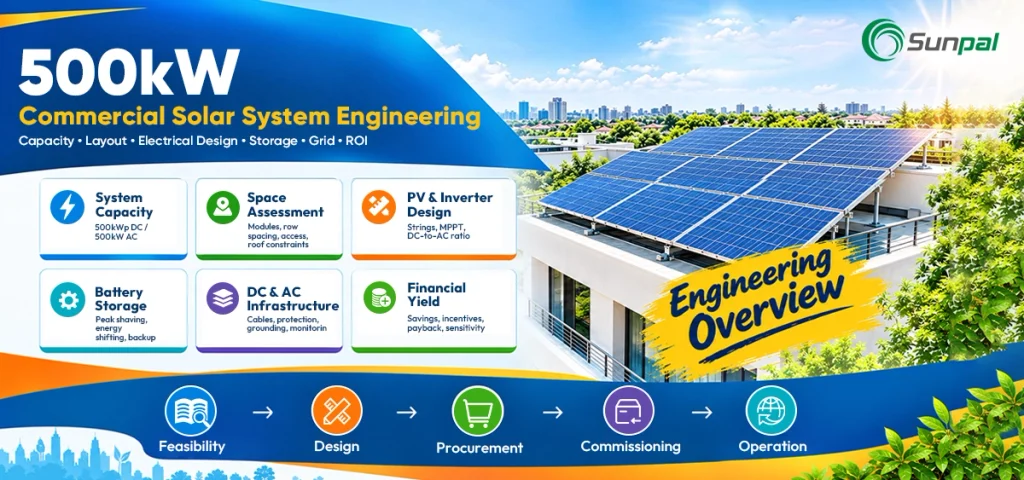
A 500kW commercial solar system can help businesses reduce grid electricity consumption, manage energy costs, and improve long-term energy resilience. For factories, logistics centers, warehouses, and large commercial buildings, a successful photovoltaic (PV) project requires more than installing high-efficiency solar panels. It depends on accurate system sizing, coordinated electrical design, structural feasibility, grid compatibility, and a clear understanding of the facility's energy demand.
From a smaller 50 kWp solar system for businesses to a 500 kW solar system or a 500 kW+ solar system serving a large industrial site, each project must be engineered around its operating conditions. Module selection, inverter configuration, transformer capacity, energy storage, and energy management all influence system performance and project economics.
This guide explains the main engineering considerations for commercial solar systems, helping project owners, EPC contractors, and procurement teams evaluate technical requirements before equipment selection and installation.
What Defines a 500kW Commercial Solar System?
A 500kW commercial solar system is a photovoltaic installation designed to deliver approximately 500 kilowatts of rated power under the applicable system rating convention. Before planning the project, it is important to distinguish between DC module capacity and AC inverter output capacity.
A system rated at 500 kWp on the DC side may have a different AC output rating, depending on inverter sizing and the selected DC-to-AC ratio. This distinction affects equipment selection, grid export limits, and performance calculations.
Typical applications include:
- Manufacturing facilities: Solar generation can offset daytime electricity demand from machinery, production lines, and ventilation systems.
- Logistics centers and warehouses: Large rooftop areas can support distributed PV arrays for lighting, refrigeration, material handling, and other operational loads.
- Commercial parks: Multiple buildings may share a coordinated solar generation and energy management strategy.
- Agricultural processing facilities: PV systems can help supply electricity for processing equipment, cooling, irrigation, and storage.
- Large commercial buildings: Offices, retail complexes, and industrial campuses may combine rooftop PV with battery storage where appropriate.
For businesses considering smaller installations, a 50 kWp solar system for businesses may be a suitable starting point. Larger facilities may require a 500 kW+ solar system with multiple inverters, more complex electrical infrastructure, and advanced monitoring.
The appropriate system capacity should be determined by electricity consumption, available installation area, grid requirements, and the project's financial objectives rather than by nominal capacity alone.
How Do You Estimate Space Requirements for a 500kW Solar Array?
The site area required for a 500kW solar project depends on the target DC capacity, selected module specifications, and the way the array is arranged. A preliminary estimate should distinguish the area occupied by the modules from the additional space needed for installation, access, and supporting infrastructure.
The approximate number of modules can be calculated using:
Number of modules = Target DC capacity ÷ Module rated power
For example, if the project targets 500 kWp of DC capacity and uses 600 W solar modules:
500,000 W ÷ 600 W ≈ 834 modules.
The final design must use a practical whole-module quantity and confirm the resulting installed capacity. This calculation is an illustration of capacity estimation, not a final equipment specification.
Account for Array Layout and Site Constraints
The module count alone does not determine the total site area. The layout must also accommodate the selected mounting configuration and the space required for installation, operation, and maintenance. For industrial rooftops, a preliminary solar feasibility assessment can help identify structural limitations, shading, and access requirements that may affect the usable area and final array layout.
Key design considerations include:
- Array geometry: Module orientation, tilt angle, row spacing, and shading-related separation.
- Mounting configuration: Roof-mounted or ground-mounted structures and their associated installation requirements.
- Structural and environmental loads: Roof capacity, wind uplift, snow loads where applicable, and foundation requirements for ground-mounted arrays.
- Access and circulation: Maintenance routes, equipment access, perimeter clearances, and applicable fire-safety provisions.
- Site infrastructure: Drainage, cable routes, inverter locations, and access roads or setbacks for ground-mounted projects.
The applicable access and fire-safety requirements depend on local regulations, building characteristics, and project conditions. They should be confirmed during site-specific design rather than treated as a universal roof-coverage percentage.
If the available site cannot accommodate the planned array, alternatives may include ground-mounted PV, solar carports, or photovoltaic facade systems. Each option requires a separate assessment of usable area, shading, structural requirements, installation costs, and expected energy yield.
How Should PV Strings and Inverters Be Configured for a 500kW+ System?
At the 500kW scale, PV module and inverter compatibility must be verified through electrical calculations. String voltage, input current, MPPT allocation, and the DC-to-AC ratio all influence system performance and equipment suitability.
Verify PV Module Compatibility
Commercial projects may use high-wattage monocrystalline or bifacial solar modules. Selection should consider rated power, temperature characteristics, mechanical requirements, electrical specifications, and long-term reliability.
Bifacial modules may provide additional generation when mounting conditions and reflected irradiance are favorable. Their benefits depend on site conditions and array design.
Calculate String Parameters and MPPT Allocation
Engineers should verify the electrical limits of each PV string before assigning strings to inverter inputs. Key checks include:
- Maximum open-circuit voltage at the lowest design temperature.
- Operating voltage across the expected temperature range.
- Combined operating and short-circuit current for parallel strings.
- Permitted string connections for each MPPT input.
- Compatibility between strings with different orientations or shading conditions.
Separate MPPT channels may help manage different array conditions, provided the configuration complies with inverter specifications.
Select Inverters and Validate System Sizing
Commercial solar inverters should match the array's voltage and current characteristics, required AC output, grid requirements, and monitoring needs.
For larger installations, engineers should also evaluate inverter quantity, output distribution, and maintenance requirements. The DC-to-AC ratio must reflect the expected generation profile, potential clipping, equipment limits, and grid export restrictions.
The final engineering design should document string calculations, MPPT assignments, inverter ratings, and relevant electrical protection requirements to support equipment verification and installation.
How Should DC and AC Electrical Infrastructure Be Designed?
A reliable commercial PV installation requires coordinated DC and AC electrical infrastructure. Incorrect cable sizing, inadequate protection, poor grounding, or insufficient fault isolation can compromise safety and system performance.
The DC side connects PV modules and strings to inverter inputs. The AC side transfers inverter output to the facility's distribution network or grid interconnection point.
The main engineering considerations include:
- DC cable sizing: Account for current-carrying capacity, installation conditions, ambient temperature, voltage drop, and applicable electrical codes.
- String protection: Determine whether string fuses, disconnects, and other protective devices are required based on the electrical configuration and relevant standards.
- AC distribution: Size conductors, switchgear, circuit breakers, and distribution equipment for expected current, fault levels, and operating conditions.
- Grounding and bonding: Provide appropriate protective grounding and equipotential bonding in accordance with applicable regulations.
- Surge protection: Assess exposure to lightning and switching surges and specify suitable protective devices.
- Electrical losses: Evaluate resistive losses across cables, connections, and distribution equipment.
- Monitoring and communications: Coordinate inverter communications, meters, sensors, and energy management equipment.
At the design stage, engineers should prepare single-line diagrams, cable schedules, protection coordination studies where required, grounding plans, and equipment specifications.
These documents help ensure that the selected components operate together as a complete commercial solar system rather than as a collection of independently selected products.
What Transformer and Grid-Connection Requirements Apply?
A 500kW solar installation may connect to an existing low-voltage distribution system or require a medium-voltage connection, depending on the facility's electrical infrastructure and local utility requirements.
Transformer capacity should not be selected using PV capacity alone. Engineers must assess existing facility loads, transformer ratings, demand patterns, simultaneous operating conditions, fault levels, and the utility's interconnection requirements.
Important considerations include:
- Existing transformer capacity and available connection points.
- Voltage level and permissible power-export limits.
- Grid protection, anti-islanding, and disconnection requirements.
- Revenue-grade metering and monitoring arrangements.
- Power factor, reactive power, and voltage-control requirements.
- Short-circuit levels and protection coordination.
- Utility approval, commissioning procedures, and required documentation.
A facility that consumes most of its solar generation during the day may have different interconnection requirements from a site that exports substantial excess electricity to the grid.
Where export is restricted, an export-limiting control system may be required. Its design should account for meter placement, communication reliability, inverter response, and the utility's acceptance criteria.
Grid connection should be evaluated early in the engineering process. Necessary transformer upgrades, switchgear modifications, or utility studies can significantly affect the project's cost and schedule.
Should a 500kW Solar System Include Battery Storage?
Battery energy storage is not mandatory for every 500kW commercial solar system. Its value depends on the facility's load profile, electricity tariffs, demand charges, backup requirements, export restrictions, and energy management objectives.
A battery energy storage system (BESS) can store surplus solar electricity and discharge it when needed. When integrated with an energy management system (EMS), it can also support coordinated control of PV generation, battery charging, facility demand, and grid imports.
The following comparison illustrates three common configurations.
| Configuration | Main objectives | Key considerations |
|---|---|---|
| Grid-connected PV only | Reduce grid electricity purchases through direct solar consumption | Simpler architecture; savings depend on solar self-consumption and export compensation |
| PV + BESS | Shift solar energy to later periods, support peak shaving, or provide specified backup functions | Additional capital cost, battery sizing, conversion losses, degradation, and replacement planning |
| PV + BESS + EMS | Coordinate PV, battery, and facility loads using operational data and control logic | Requires suitable metering, communications, control strategies, and system integration |
How Should Battery Capacity Be Determined?
Battery power and energy capacity are different specifications. Battery power, measured in kW, determines how quickly the battery can charge or discharge. Battery energy capacity, measured in kWh, indicates how much energy it can store.
A suitable design should evaluate:
- The timing and duration of electricity demand peaks.
- The amount of excess PV generation available for charging.
- Required discharge power and usable energy.
- Battery round-trip efficiency and operating limits.
- Backup load requirements, if backup operation is required.
- Permitted charging and discharging schedules.
- Safety provisions, thermal management, and battery warranties.
A 500kW PV system does not automatically require a 500kW battery or any particular number of battery storage hours. Storage should be sized according to the intended service and measured or forecast load profile.
For commercial and industrial facilities with complex energy demand, an integrated PV, battery, and EMS design can improve operational control, provided that the expected benefits justify the added investment and operating requirements.
How Can Energy Yield, Losses, and System Performance Be Estimated?
The annual energy yield of a 500kW solar system depends on solar irradiance, module orientation, shading, temperature, system losses, inverter performance, and equipment availability.
Rated capacity alone cannot determine annual electricity generation. Two systems with the same installed capacity may produce substantially different amounts of electricity if they are installed in different climates or operate under different site conditions.
A preliminary estimate can be expressed as:
Annual energy yield ≈ Installed DC capacity × Specific annual yield
Specific annual yield is expressed in kWh/kWp per year and must be estimated using location-specific solar data and an appropriate system model.
For example, a hypothetical 500 kWp system with an assumed specific yield of 1,200 kWh/kWp per year would generate approximately 600,000 kWh annually. This is an illustrative calculation, not a production forecast for a particular site.
Key Sources of Energy Loss
A professional yield assessment should account for:
- Shading from nearby buildings, trees, rooftop equipment, and adjacent module rows.
- Module temperature and associated power reduction.
- Soiling, snow, and other environmental effects.
- Module mismatch and DC wiring losses.
- Inverter conversion losses and potential clipping.
- AC wiring and transformer losses.
- Equipment downtime and system availability.
- Grid curtailment and export restrictions.
Performance modeling should use credible meteorological data, documented design assumptions, and suitable simulation software. Where appropriate, engineers should compare expected generation with facility load data to estimate self-consumption, grid imports, and potential electricity exports.
For an initial estimate of solar electricity production, project teams can use the PVWatts Calculator to estimate PV system energy output based on system specifications and local solar resource data. The results provide a preliminary reference and should be supplemented by a site-specific engineering assessment.
After commissioning, monitoring data can be used to compare actual performance against the model and identify unexpected losses, equipment faults, or operational issues.
What Drives the Cost and ROI of a 500kW Solar Project?
The economics of a 500kW commercial solar project depend on installed system cost, electricity prices, self-consumption, export compensation, financing, maintenance, and the project's operating conditions.
A project budget should consider more than solar modules and inverters. Depending on the site, major cost categories may include:
- PV modules, inverters, mounting structures, and DC/AC cabling.
- Engineering, procurement, construction, and project management.
- Roof reinforcement or other structural modifications.
- Transformer upgrades, switchgear, and grid interconnection.
- Battery storage, fire protection, and EMS integration.
- Monitoring, commissioning, testing, and documentation.
- Insurance, maintenance, component replacement, and end-of-life planning.
Estimating Financial Returns
A simplified annual financial assessment can be based on the value of solar electricity consumed on-site, export revenue, and any verified additional operational benefits, less operating and maintenance costs.
The financial model should account for:
- Electricity tariff structures and time-of-use pricing.
- Demand charges where applicable.
- The proportion of solar generation consumed on-site.
- Export compensation and grid-imposed limitations.
- Battery efficiency, degradation, and replacement costs.
- Financing costs, taxes, and eligible incentives.
- Expected energy production over the project's operating life.
In the United States, some eligible clean electricity projects may qualify for federal tax incentives, including the technology-neutral Clean Electricity Investment Credit under Section 48E. Project owners should consult the IRS's official Clean Electricity Investment Credit guidance to verify eligibility requirements and applicable credit provisions before including potential incentives in a financial model.
A project should not assume that every commercial installation automatically qualifies for a particular credit rate.
For a more reliable investment decision, compare the base case with alternative scenarios for electricity prices, annual energy yield, capital costs, battery operation, and incentive eligibility. This sensitivity analysis helps reveal which assumptions have the greatest effect on payback and long-term returns.
What Engineering Checks Are Essential Before Commissioning?
Commissioning confirms that the installed PV system matches its approved design and can operate safely under the applicable requirements. Testing should be completed by qualified personnel using procedures appropriate to the equipment, system voltage, and local electrical standards.
Before energization and grid connection, the project team should verify the following areas.
Design and equipment verification
- Confirm module, inverter, transformer, and protection-device specifications.
- Verify that installed equipment matches approved drawings and schedules.
- Check string configuration, polarity, and permissible voltage and current.
- Review cable sizing, routing, labeling, and termination quality.
Electrical safety
- Perform applicable insulation-resistance and continuity tests.
- Verify grounding and bonding arrangements.
- Check disconnects, circuit breakers, fuses, and surge-protection devices.
- Confirm protective settings and required functional tests.
Grid and control functions
- Verify grid protection and anti-islanding functions where required.
- Confirm meter installation, export limitation, and power-control settings.
- Test communications between inverters, meters, EMS, and monitoring platforms.
- Verify battery control, operating limits, and backup functions if installed.
Monitoring and documentation
- Confirm that monitoring data is being recorded correctly.
- Review alarms, operating status, and communications reliability.
- Complete required inspection and utility approval procedures.
- Provide commissioning records, as-built drawings, equipment manuals, and maintenance instructions.
The commissioning process should conclude with documented test results and formal acceptance in accordance with the project contract and applicable regulations.
500kW Solar System Engineering Checklist
Use this checklist to review key requirements before finalizing a 500kW solar project.
| Checklist Item | Key Requirements |
|---|---|
| System Capacity | Confirm DC/AC rating and target capacity. |
| Site Feasibility | Check roof structure, usable area, shading, and access. |
| PV Modules | Verify power rating, electrical specifications, and warranties. |
| String Design | Check voltage, current, and MPPT allocation. |
| Inverters | Confirm AC capacity, DC-to-AC ratio, and grid compatibility. |
| Electrical Infrastructure | Review cables, switchgear, grounding, and protection. |
| Grid Connection | Verify transformer capacity, export limits, and utility approval. |
| Battery Storage | Assess BESS requirements, power, and energy capacity. |
| EMS and Monitoring | Define metering, controls, and monitoring requirements. |
| Energy Yield | Estimate annual generation and system losses. |
| Project Economics | Evaluate costs, savings, operating expenses, and incentives. |
| Commissioning | Complete testing, inspections, and handover documentation. |
This checklist supports preliminary project reviews but does not replace detailed engineering calculations or local code compliance checks.e project-specific engineering calculations, professional inspections, or local code compliance reviews.
Frequently Asked Questions
How many solar panels are needed for a 500kW commercial solar system?
A 500kWp DC commercial solar installation requires approximately 800 to 860 high-efficiency PV modules when using modern 580W to 620W N-Type TOPCon panels. This footprint occupies approximately 2,500 to 3,500 m² (27,000–37,500 sq.ft) of usable rooftop or ground space, depending on module tilt angles, row spacing, and shading clearance.
How much electricity can a 500kW solar system generate per year?
Under standard operating conditions with 4.0 to 5.5 daily peak sun hours and an 80%–82% system Performance Ratio (PR), a 500kWp system generates approximately 600,000 kWh to 850,000 kWh of AC electricity annually. Exact yield must be verified via site-specific PVsyst 3D shading and meteorological simulation reports.
What inverter configuration is recommended for a 500kW commercial solar system?
The standard engineering solution utilizes a decentralized multi-string inverter topology—typically four to five 110kW or 125kW 3-phase string inverters configured with a 1.2x to 1.4x DC/AC oversizing ratio (600kWp–700kWp DC PV array). This multi-MPPT setup improves localized power tracking across varied roof sections and prevents single-point plant shutdown.
Does a 500kW commercial solar system require battery energy storage (BESS)?
No, battery storage is not mandatory for grid-tied operations. A pure grid-tied 500kW system provides the highest immediate ROI for daytime-operating factories. However, adding a 500kWh to 1MWh C&I BESS is highly advantageous when mitigating high Peak Demand Charges, navigating zero-export grid constraints, or enabling emergency backup for critical assembly lines.
What transformer capacity is required for a 500kW solar project grid connection?
A 500kW (AC) solar power plant typically requires a 630 kVA or 800 kVA step-up transformer to step AC output voltage up to the local medium-voltage grid (e.g., 10kV, 20kV, or 35kV). The transformer rating accounts for peak AC power output, power factor adjustments (±0.9 leading/lagging), and a 15%–20% thermal safety margin.
What is the main difference between a 500kW and a 500kW+ solar installation in engineering scope?
Projects exceeding 500kW (500kW+) transition from simple low-voltage (LV) net-metering to complex medium-voltage (MV) grid interconnections. This engineering shift requires dedicated MV switchgear, formal utility grid impact/short-circuit studies, SCADA remote telemetry, Power Plant Controllers (PPC) for active/reactive power regulation, and anti-islanding protection relays.
Can photovoltaic facade (BIPV) systems supplement commercial rooftop solar?
Yes. Photovoltaic facades and solar cladding provide valuable supplementary generation when rooftop space is constrained or during winter months when lower sun angles favor vertical surfaces. While vertical facades yield 20%–30% less annual kWh per kWp than optimal tilted roofs, they generate steady off-peak power profiles and enhance corporate green building certifications.
Get a Tailored Solar System Assessment From SUNPAL PV
Every commercial solar project is shaped by its site conditions, electricity demand, existing electrical infrastructure, and long-term energy objectives. Whether a business is planning a 50 kWp commercial installation, a standalone 500 kW solar plant, or a 500 kW+ PV system integrated with battery storage, the system configuration should reflect the project's actual operating requirements rather than rely on a one-size-fits-all approach.
To support an initial technical assessment, prepare the following project information:
- Project location: Country, region, and relevant site conditions.
- Electricity demand: Recent electricity bills, interval load data, or an available load profile.
- Available installation area: Usable rooftop or ground area, roof drawings, and known structural constraints.
- Target system capacity: Intended DC or AC capacity and potential future expansion.
- Grid conditions: Existing transformer information, connection voltage, and export limitations, where known.
- Storage objectives: Requirements for peak shaving, energy shifting, backup power, or energy management system (EMS) integration.
SUNPAL PV provides photovoltaic products and configuration support for commercial and industrial solar applications, including rooftop installations, large-scale distributed PV projects, and PV systems integrated with battery storage.
A well-engineered solar system brings equipment selection, electrical safety, grid integration, energy performance, and financial objectives together from the earliest design stage. With reliable site data and a coordinated engineering approach, businesses can evaluate system options more effectively and make better-informed decisions about their commercial solar investments.