


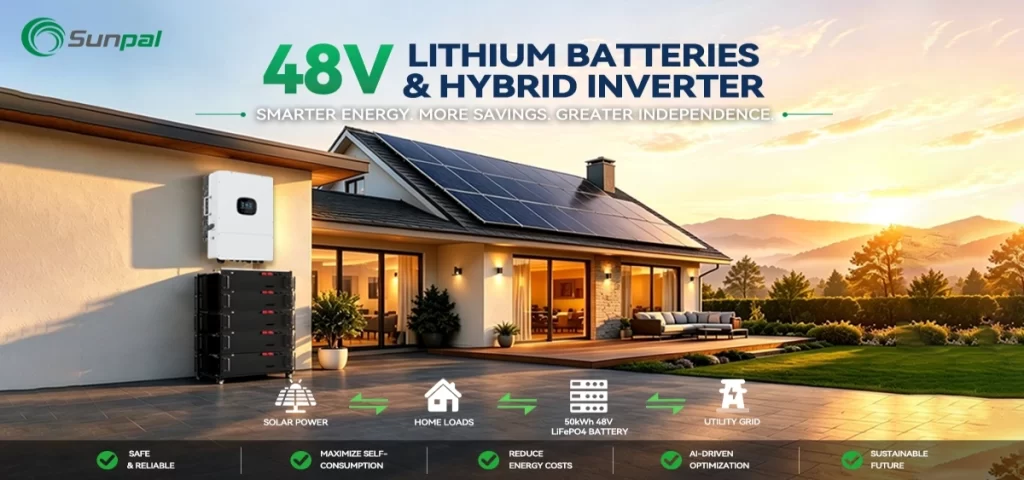
As residential and small commercial solar systems continue to evolve, lithium battery storage combined with hybrid inverters has become a key solution for improving energy independence, reducing electricity costs, and maximizing solar energy utilization. Sunpal Solar Hybrid Inverters are designed to provide reliable compatibility with 48V lithium battery systems, enabling efficient solar storage solutions with intelligent energy management, flexible operation modes, and stable battery communication.
The adoption of hybrid inverters is accelerating worldwide. According to 2026 Industry Research and Precision Reports, lithium battery-integrated hybrid inverters are gaining significant market share as more users shift toward solar-plus-storage systems. Meanwhile, Research and Markets highlight strong growth in the global 48V inverter and battery storage markets, driven by rising demand for flexible and scalable energy solutions.
A properly designed 48V battery hybrid inverter system integrates solar generation, LiFePO4 battery storage, intelligent BMS communication, and energy management to deliver safer operation, higher efficiency, and more flexible power management.
The Importance of 48V Lithium Battery and Hybrid Inverter Integration
A hybrid inverter is the central energy conversion device in a solar storage system, managing power flow between solar panels, batteries, household loads, and the grid. When integrated with a 48V lithium battery, the inverter works together with the battery management system (BMS) to ensure stable charging, discharging, and protection control.
Unlike traditional lead-acid batteries, LiFePO4 batteries require precise monitoring of voltage, current, temperature, and operating status. Therefore, successful system integration depends not only on hardware connections but also on reliable communication between the battery BMS and inverter. Understanding 48V lithium battery technology, lifespan factors, charging requirements, and BMS protection strategies is also essential for achieving long-term performance, safety, and efficiency in solar storage systems.
Through CANbus or RS485 communication, the battery provides real-time data including:
- Battery State of Charge (SOC);
- Charging and discharging current limits;
- Battery voltage and temperature;
- Protection status.
The hybrid inverter then adjusts operating parameters based on battery conditions, enabling safer operation, higher efficiency, and optimized energy management.
How a 48V Battery Hybrid Inverter System Works
A typical 48V lithium battery hybrid inverter system includes four major components:
Solar PV Modules → Hybrid Inverter → 48V Lithium Battery → Energy Loads/Grid
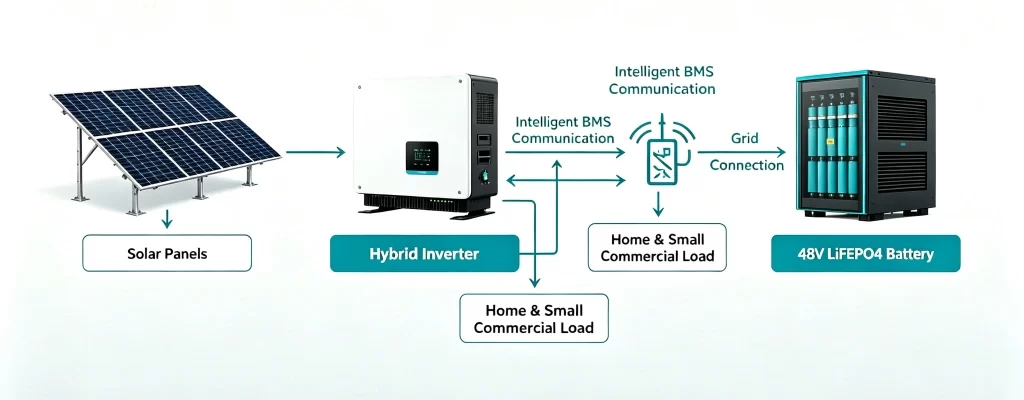
During daytime operation, solar panels generate electricity. The hybrid inverter prioritizes solar power for household consumption while directing excess energy to charge the battery.
When solar generation decreases or electricity demand increases, the stored energy in the 48V lithium battery is automatically discharged to supply loads. If additional power is required, the system can import electricity from the grid.
This intelligent energy flow allows users to maximize renewable energy utilization while reducing dependence on grid electricity.
AI-Based Smart Energy Management for 48V Battery Systems
Modern hybrid inverter systems are increasingly equipped with AI-powered Energy Management Systems (EMS), which automatically optimize battery charging, discharging, and energy flow based on real-time data. According to Precision Reports, 52% of newly installed residential solar storage systems now include smart monitoring capabilities, while more than 41% of hybrid inverter users require AI-driven energy optimization features, including peak price prediction and dynamic virtual power plant (VPP) scheduling.
Instead of relying on fixed charging and discharging schedules, AI EMS analyzes multiple data sources, including:
- Real-time solar generation;
- Household electricity consumption;
- Battery status;
- Weather forecasts;
- Electricity price changes.
Based on predictive algorithms, the system determines the most efficient energy strategy.
For example, on a sunny day, the EMS can prioritize solar self-consumption and charge the 48V lithium battery with surplus photovoltaic energy. Before periods of low solar generation, the system can reserve battery capacity to maintain energy availability.
By learning household consumption patterns, AI EMS can predict future electricity demand and prepare the battery accordingly. This improves energy independence and increases the overall performance of residential solar storage systems.
Dynamic Energy Optimization and Grid Interaction
AI-based energy management also improves the economic performance of solar storage systems by adapting to electricity pricing changes and grid conditions.
Under time-of-use tariffs, the system can:
- Charge batteries during low-price periods;
- Store excess solar energy;
- Discharge stored energy during peak pricing hours;
- Export power when grid conditions are favorable.
For commercial applications, intelligent peak shaving functions can reduce grid demand by using stored battery energy during high-consumption periods.
In areas with strict export regulations or dynamic electricity pricing, AI EMS can also control grid injection and optimize PV output to improve system efficiency and reduce unnecessary costs.
Ensuring Battery Inverter Compatibility
One of the most important factors in lithium battery integration is battery inverter compatibility.
A compatible system requires matching:
- Battery voltage range;
- Communication protocol;
- CANbus or RS485 settings;
- BMS firmware;
- Inverter battery mode configuration.
Compared with high-voltage battery systems, 48V low-voltage battery solutions provide a more open ecosystem with broader hardware and software compatibility. According to Savolture energy storage analysis, 48V systems can integrate with mainstream hybrid inverter platforms such as Deye, Solis, Growatt, and GoodWe, helping reduce ecosystem limitations commonly associated with high-voltage solutions.
Sunpal 48V lithium battery storage systems feature an intelligent built-in BMS and support closed-loop communication with compatible hybrid inverters through standard CANbus and RS485 protocols.
Supported mainstream inverter brands include:
- Deye – Supports closed-loop communication through CANbus or RS485 for real-time battery data exchange.
- Solis – Compatible with low-voltage 48V hybrid inverter series for residential energy storage applications.
- Growatt – Supports integration with popular SPF and SPH energy storage inverter models.
- LuxPower – Enables simplified protocol matching for easier system commissioning.
By ensuring proper communication between the battery BMS and inverter, Sunpal 48V battery systems can achieve accurate SOC monitoring, optimized charging and discharging control, and safer system operation.
Before installation, installers should always verify inverter compatibility, communication protocol, and firmware version to ensure reliable system performance.
Parallel Connection for Expanded Energy Storage Capacity
For households and small commercial applications requiring higher storage capacity, multiple 48V lithium battery modules can be connected in parallel.
Parallel battery expansion allows users to increase available energy storage while maintaining the same system voltage.
Before connecting multiple battery units, the following conditions should be confirmed:
- All batteries should be the same model and capacity;
- Battery firmware versions should be compatible;
- Communication addresses should be correctly configured;
- Power cables should be properly sized;
- The inverter should support parallel battery operation.
During installation, one battery module is configured as the Master Battery, while additional units operate as Slave Batteries. The Master Battery communicates with the hybrid inverter and manages battery synchronization.
Through correct parallel configuration, multiple Sunpal 48V lithium battery modules can work together to provide larger energy storage capacity for different residential and small commercial energy storage applications.
Cloud Monitoring and Remote Management
Modern solar storage systems are increasingly equipped with cloud-based monitoring platforms, allowing users and installers to remotely monitor system performance and manage energy operations.
Typical monitoring functions include:
- PV production monitoring;
- Battery SOC tracking;
- Grid energy import and export;
- Energy consumption analysis;
- Battery charging and discharging status;
- System performance reports;
- Fault alerts and operational notifications.
Through cloud monitoring, users can track daily energy flows, evaluate system performance, and identify potential issues remotely. This improves system reliability, simplifies maintenance, and helps optimize overall energy utilization.
Future Trends in 48V Lithium Battery Solar Integration
The combination of lithium battery storage, hybrid inverters, and AI-based energy management is shaping the future of distributed renewable energy systems.
According to Mordor Intelligence 2026 data, lithium iron phosphate (LiFePO4/LFP) batteries have reached approximately 72.9% market share in global residential energy storage applications. With advantages such as 6,000+ charge cycles, excellent thermal stability, and high safety performance, LiFePO4 continues to strengthen its position in residential energy storage.
As renewable energy adoption grows and electricity markets become more dynamic, future 48V battery systems will focus on higher intelligence, greater interoperability, and improved grid interaction. Advanced BMS technology, AI-driven optimization, and flexible system expansion will further enhance the performance of solar-plus-storage solutions.
Conclusion
The integration of 48V lithium batteries with hybrid inverters represents a major step toward smarter and more flexible solar energy systems. By combining reliable battery technology, intelligent BMS communication, open inverter compatibility, and advanced energy management, modern storage solutions enable higher efficiency, improved safety, and greater energy independence.
Sunpal 48V lithium battery storage systems are designed to support this evolving energy landscape with intelligent BMS technology, flexible system expansion, and compatibility with mainstream hybrid inverter platforms. By providing reliable solar-plus-storage solutions for residential and small commercial applications, Sunpal helps users maximize renewable energy utilization and build a more sustainable energy future.