


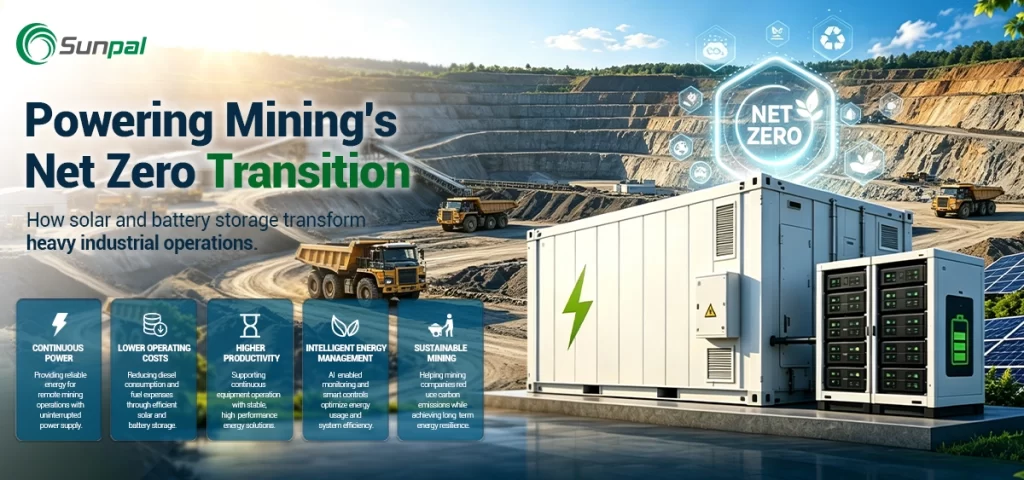
Executive Summary
In the sun-drenched Pilbara region of Western Australia, mining powerhouse Fortescue is engineering what it calls the world's largest off-grid renewable energy system dedicated to heavy industry. The project pairs massive solar farms with up to 5 GWh of battery energy storage systems (BESS), alongside wind generation, to power iron ore operations around the clock while slashing fossil fuel dependence.
This ambitious initiative accelerates Fortescue's “Real Zero” target—eliminating Scope 1 and 2 emissions from its Pilbara operations—to as early as 2028, two years ahead of the original 2030 timeline. With 1.2 GW of solar capacity, over 600 MW of wind, and 4–5 GWh of BESS at full scale, the system promises stable, dispatchable green power for mining and processing.
For the broader mining sector, Fortescue's project illustrates how solar plus storage solutions deliver not only deep decarbonization but also cost savings, energy security, and operational resilience. This case study explores the technical, economic, and strategic drivers behind this transformation and its implications for mining giants worldwide.
The Energy Challenge Facing Modern Mining
Mining ranks among the most energy-intensive industries, powering massive haul trucks, crushers, conveyors, and processing plants. Remote locations often rely on diesel generators or gas-fired power, exposing operations to volatile fuel prices, supply chain disruptions, and high carbon emissions.
Globally, the sector faces mounting pressure: investor demands for net-zero commitments, carbon pricing mechanisms, and downstream customers (especially in steel and EV supply chains) seeking low-emission materials. Diesel can account for a significant portion of operating costs at off-grid sites, while reliability concerns persist amid extreme weather and logistical challenges.
Renewable energy, particularly solar PV paired with battery storage, has emerged as a compelling solution. Plummeting costs for solar modules and lithium-ion (or advanced) batteries, combined with improving energy management systems, enable high renewable penetration without compromising uptime. Mining companies can now achieve “firm” renewable power—available 24/7—through hybrid microgrids that integrate solar generation with storage for shifting energy to peak or nighttime demand.
Solar + Storage Delivers Lower, More Stable Energy Costs for Mining Operations
Traditional Diesel/Gas vs. Solar + BESS Hybrid (Firm Power) • Fortescue-Scale Projection
Key Project Highlights
2025 Baseline
Diesel generation dominates with high logistics costs and fuel price volatility.
2027 Partial Rollout
~290 MW renewables online with initial BESS delivering approximately USD 100M annual fuel savings.
2028 Full System
1.2 GW Solar + 600 MW Wind + 4–5 GWh BESS providing 24/7 dispatchable renewable power.
2030+
Battery prices continue falling while AI optimization further lowers operating costs.
Fortescue's Bold Bet: Building the Pilbara Green Grid
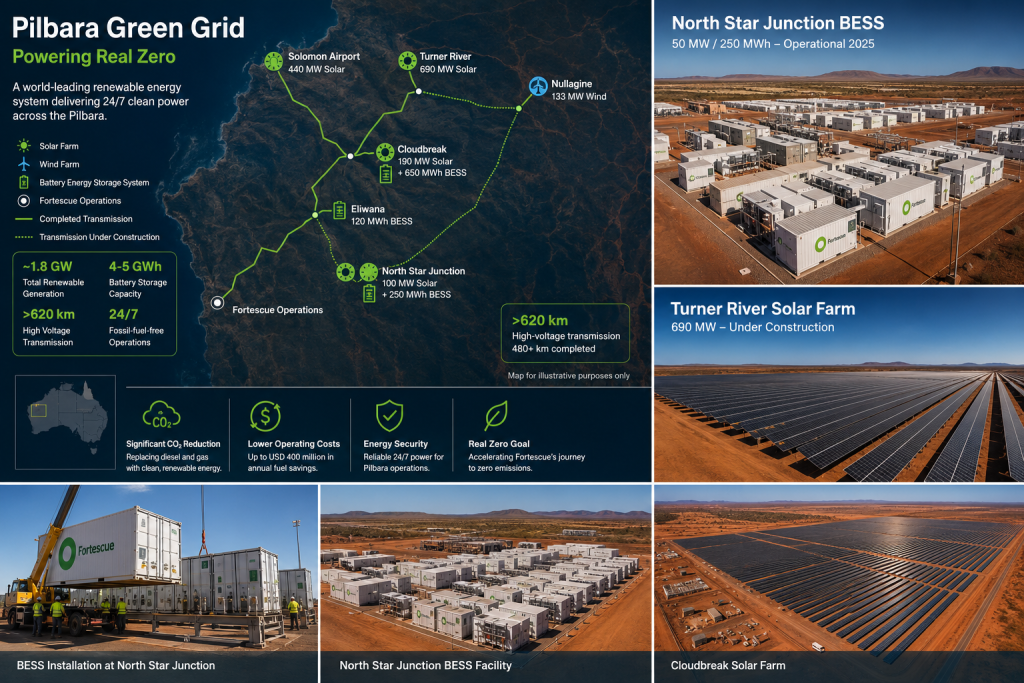
Fortescue, the world's fourth-largest iron ore producer, has fast-tracked its decarbonization program. The company is constructing an “islanded” high-voltage renewable network that operates independently, combining utility-scale solar, wind, multi-gigawatt-hour BESS, and extensive transmission infrastructure.
Key project milestones and specifications:
- Solar capacity: Targeting 1.2 GW total, including major farms like the 690 MW Turner River (under construction, expected 2028), 440 MW Solomon Airport, 190 MW Cloudbreak, and 100 MW North Star Junction.
- Wind: Over 600 MW, with projects like the 133 MW Nullagine.
- Battery storage: Up to 4–5 GWh rollout. First large-scale system: 50 MW / 250 MWh BYD Blade BESS at North Star Junction (delivered 2025), storing daytime solar for nighttime use. Next: 120 MWh at Eliwana (early 2026), plus 74 MW / 650 MWh at Cloudbreak.
- Transmission: Over 480 km of high-voltage lines built, expanding to >620 km to connect mines, rail, and ports.
- Timeline acceleration: 290 MW renewables by early 2027 for daytime “green processing”; 24-hour fossil-free operations later in 2027; full system by end-2028.
The AUD 3.56 billion (~USD 2.5 billion) investment uses LONGi solar panels, BYD batteries, and Envision wind turbines, supported by AI-driven optimization.
How Solar + Storage Powers Reliable Mining Operations
The synergy between solar PV and BESS is transformative for variable mining loads. Daytime solar directly powers operations, while batteries store excess energy for evenings, cloud cover, or peaks. Advanced inverters and energy management systems ensure seamless integration with any remaining gas assets during transition.
In Fortescue's setup, BESS provides grid stability, frequency regulation, and black-start capability—critical for remote microgrids. BYD's Blade batteries feature liquid cooling suited to Pilbara's harsh conditions.
Technical advantages:
- High renewable penetration (targeting near-100% over time).
- Peak shaving and load shifting reduce curtailment and backup fuel use.
- Improved power quality and reduced wear on generators.
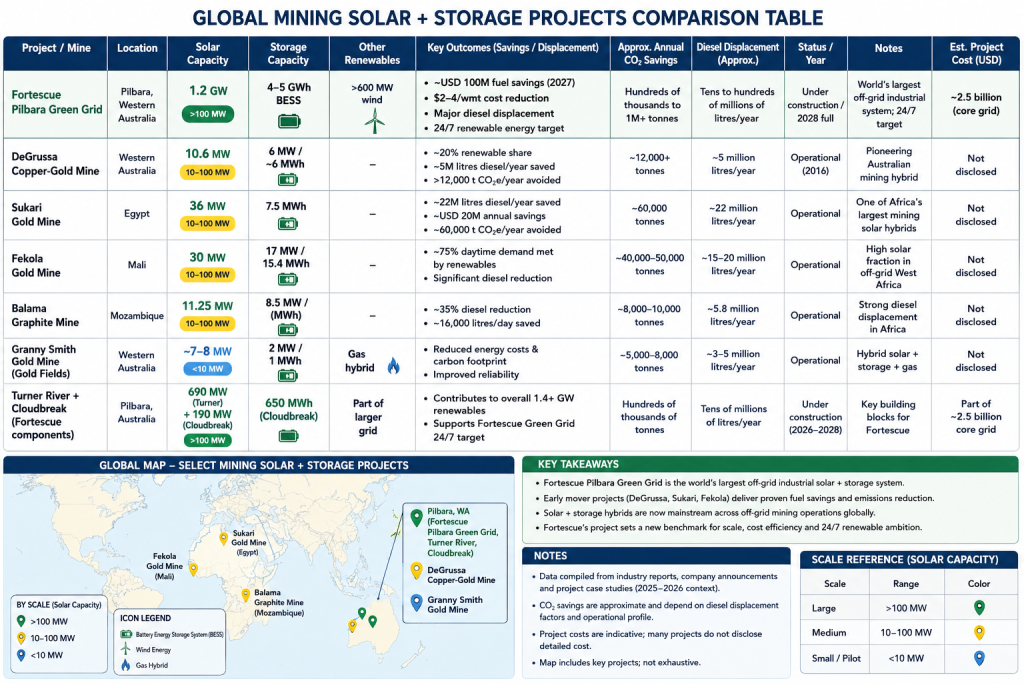
Real-world parallels include smaller hybrids like the DeGrussa copper mine (10.6 MW solar + 6 MW BESS, ~20% renewable share, millions of liters diesel saved) and Sukari Gold Mine in Egypt (36 MW solar + storage, ~22 million liters diesel displaced annually).
Fortescue's scale sets a new benchmark, proving solar plus storage can firm renewables for heavy industrial demand.
Quantifying the Wins: Economics, Emissions, and Resilience
Fortescue expects significant savings: ~AUD 142 million (~USD 100 million) in fossil fuel costs by next year, with unit cost reductions of $2–4 per wet metric ton upon completion.
Emissions reductions will be substantial as diesel and gas are displaced, supporting broader green steel ambitions. Energy security improves by mitigating global fuel price volatility and logistics risks in remote areas.
Beyond direct savings, benefits include enhanced ESG performance for financing, potential new revenue streams (e.g., licensing green power expertise), and workforce safety from fewer fuel trucks.
Projected Environmental and Economic Benefits – Fortescue Pilbara Green Grid
CO₂ Reduction • Diesel Displacement • Cost Savings Across Project Phases (2025–2030+)
Project Phase Impact Breakdown
| Project Phase | CO₂ Savings | Diesel Displacement | Annual Savings | C1 Cost Impact |
|---|---|---|---|---|
| 2025 Baseline | 0 | Baseline Diesel Use | - | - |
| 2027 Partial Rollout | 150k–300k tCO₂e | 50–80M L | ~$100M | $1–2/t |
| 2028 Full System | 500k–800k+ tCO₂e | 150–250M+ L | $300–500M | $2–4/t |
| 2030+ Optimized | 700k–1M+ tCO₂e | 200–400M+ L | $500–800M+ | $2–4+/t |
Overcoming Challenges in Large-Scale Deployment
Scaling solar + storage in mining presents hurdles: extreme heat/dust affecting equipment, high initial capex, supply chain demands for batteries, and integration with legacy systems. Community engagement, especially with Traditional Owners in Australia, and end-of-life battery management are also key.
Fortescue mitigates these through proven technologies (e.g., robust Blade batteries), phased rollout, in-house AI optimization, and approved budgets. Early milestones like the operational North Star BESS demonstrate progress.
Industry-wide lessons emphasize starting with hybrid approaches (renewables + existing thermal) before full transition, prioritizing high-diesel-use sites.
Industry-Wide Ripple Effects and Replicability
Fortescue's success inspires peers. Companies like Rio Tinto, BHP, and Anglo American pursue similar renewables. Solar plus storage projects are expanding in Africa, South America, and beyond—e.g., hybrids in Mali, Senegal, and Mozambique delivering 20–35%+ diesel reductions.
This model supports critical mineral supply for the energy transition itself (iron for infrastructure, future battery minerals). It also opens opportunities for “green power as a service” models.
The Road Ahead: Innovation and Scalability
Future advancements—longer-duration storage, sodium-ion alternatives, better AI forecasting, and hybrid wind-solar systems—will lower costs further and boost reliability. Fortescue eyes ~2 GW total generation and potential expansion of its green grid expertise into new business lines.
For mining executives, recommendations include conducting site-specific feasibility studies, partnering with experienced integrators (e.g., for BESS supply), and aligning with policy incentives for renewables.
Conclusion
Fortescue's Pilbara Green Grid exemplifies how solar energy combined with advanced battery storage is driving mining giants toward net-zero goals. By delivering reliable, cost-competitive clean power at unprecedented scale, this project proves that deep decarbonization is not only feasible but strategically advantageous—enhancing resilience, cutting costs, and future-proofing operations.
As solar plus storage technologies mature and economics improve, more mining operations worldwide will follow this path, accelerating the industry's contribution to global sustainability. The sun and batteries are powering a new era for heavy industry.