


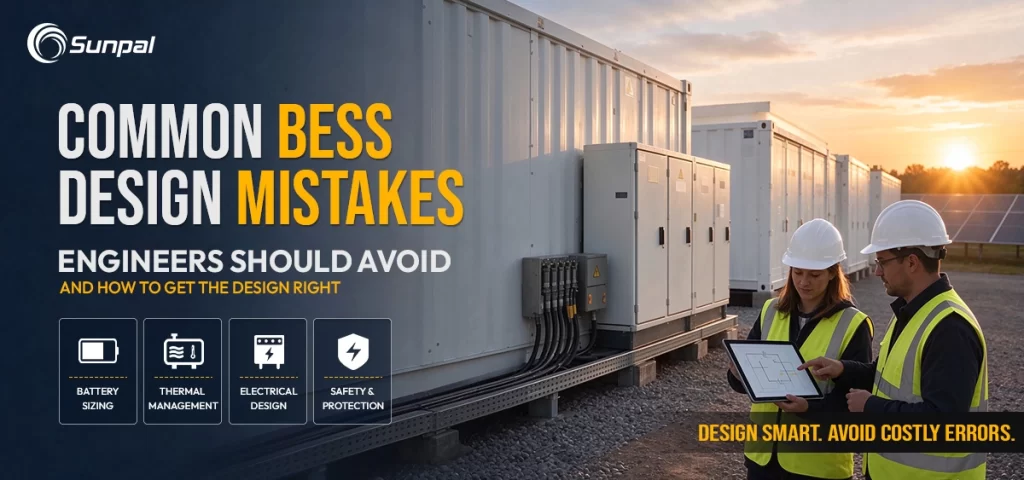
Battery energy storage systems have become essential companions to modern solar installations. As solar-plus-storage projects scale from commercial rooftops to multi-hundred-megawatt solar farms, the pressure on engineers to deliver safe, reliable, and cost-effective designs has never been higher. Yet industry data consistently shows that a significant share of performance shortfalls, safety incidents, and budget overruns originate in the design phase rather than in cell manufacturing alone.
This article examines the most frequent BESS design mistakes that continue to trip up even experienced teams. Each section explains why the error occurs, the real-world consequences, and practical steps to avoid it. The goal is straightforward: help engineers building solar energy storage systems deliver projects that perform as promised over their full lifetime.
Why Design-Phase Decisions Matter More Than Ever
Grid-scale battery storage and hybrid solar systems now routinely incorporate lithium-ion BESS for peak shaving, load shifting, frequency regulation, and renewable firming. When design assumptions prove incomplete, the results appear quickly: accelerated capacity fade, thermal events, interconnection delays, or systems that never achieve the modeled round-trip efficiency.
Public analyses of failure incidents repeatedly point to integration, thermal management, fire protection strategy, and sizing decisions as leading contributors. Addressing these issues early is far less expensive than correcting them after equipment has been procured or construction has begun.
Skipping the Hazard Mitigation Analysis: An Expensive Early Blind Spot
One of the most common and costly mistakes is treating the Hazard Mitigation Analysis as a late-stage permitting document rather than a core design activity. Codes such as NFPA 855 and the International Fire Code require an HMA, yet many project teams complete the bulk of the layout, equipment selection, and even procurement before the analysis begins.
When the HMA finally arrives, it often reveals the need for greater separation distances between containers, enhanced ventilation, different suppression approaches, or additional gas detection. The result is redesigns, change orders, and schedule slips that ripple through the entire solar-plus-storage project.
How to avoid it: Begin the HMA during schematic design. Involve the fire protection engineer, system integrator, and Authority Having Jurisdiction from the start. Base the analysis on UL 9540A test data that matches the specific battery chemistry, module arrangement, and enclosure design. Document assumptions clearly so later design changes can be evaluated against the original hazard assessment.
Thermal Management Failures That Quietly Destroy Performance
Batteries are highly sensitive to temperature. Inadequate thermal design remains one of the most frequent reasons solar energy storage systems underperform or experience premature degradation. Common errors include undersized HVAC or liquid-cooling systems, insufficient redundancy, poor airflow distribution inside containers, and designs that ignore local climate extremes or auxiliary heat loads.
In hot climates, a cooling system operating at its limit leaves little margin. Cell temperatures climb, internal resistance rises, and capacity fade accelerates. Coolant leaks from poorly designed or poorly installed liquid systems introduce additional electrical and corrosion risks. Over time, the system that looked efficient on paper delivers lower usable energy and higher operating costs.
Practical safeguards: Size thermal systems for the highest expected ambient temperature plus full continuous operation, not average conditions. Require detailed thermal modeling from the supplier that accounts for the actual rack layout. Specify monitoring of temperature differentials across the pack, coolant temperatures, and fan or pump status. Design for maintainability—filters, pumps, and heat exchangers must be accessible without major disassembly. In solar hybrid projects, coordinate BESS thermal loads with the overall site energy balance so auxiliary power does not erode net output.
Chiller → Supply Manifold → Cold Plates → Return Manifold → Chiller.
Filtered air intake → Internal circulation → Heat removal through exhaust paths.
Temperature sensors → BMS → Cooling system control and thermal management.
Treating BESS Containers Like Ordinary Electrical Rooms
Lithium-ion battery enclosures behave very differently from traditional switchgear rooms. Heat and flammable gases can accumulate rapidly during a fault. Assuming that standard sprinkler systems or conventional ventilation will handle a thermal runaway event is a dangerous oversimplification.
Additional frequent errors include weak integration between the battery management system and fire detection or suppression systems, reliance on generic suppression agents not proven for the specific chemistry, inadequate deflagration venting, and insufficient separation between units. Industry quality audits have repeatedly found defects in fire detection wiring, non-responsive actuators, and incomplete gas management provisions.
Better approach: Design to the specific hazards identified in the HMA and supported by UL 9540A data for the chosen configuration. Provide layered detection that includes off-gas sensors in addition to smoke and heat. Ensure the BMS can communicate critical alarms directly to the fire system and initiate predetermined responses. Incorporate explosion control measures consistent with NFPA 68 and 69 where required. Prioritize early detection and propagation barriers at the module and rack level rather than relying solely on enclosure-level suppression after a fire is fully developed.
These measures are especially critical in dense solar farm layouts where multiple BESS containers sit near photovoltaic arrays and inverters.
Getting the Sizing Wrong: Overbuilding or Undercutting the Business Case
System sizing mistakes appear in two opposite forms. Some teams size strictly to peak load without considering load diversity or the fact that not every load requires full backup. Others aggressively reduce capacity to meet a capital budget target, ignoring depth-of-discharge limits, round-trip efficiency, degradation over 10–15 years, and auxiliary loads.
The first approach wastes capital on underutilized capacity. The second produces a system that cannot meet contractual energy or power commitments once real-world losses and capacity fade take effect. In solar-plus-storage applications, inaccurate modeling of solar production variability compounds the problem.
Sound practice: Start with detailed load profiles and solar resource data. Apply realistic DoD limits for the chosen chemistry (typically 80–90% for modern lithium iron phosphate). Factor in round-trip efficiency, parasitic loads, and a degradation curve that reflects expected cycling and temperature conditions. Build sensitivity cases for extended low-solar periods. Distinguish clearly between nameplate and usable energy in all financial and technical models. When value-engineering pressure arises, protect the thermal and power conversion margins that preserve long-term performance.
[Suggested chart: Example capacity fade curve over 15 years under different average operating temperatures]
Overlooking Component Compatibility and True System Integration
A containerized BESS is not a simple appliance. It contains cells, modules, racks, battery management systems, power conversion systems, thermal equipment, fire systems, and communications hardware that often come from multiple suppliers. Treating these elements as interchangeable or assuming factory integration will resolve all interface issues is a frequent source of later problems.
Wiring errors, grounding deficiencies, incompatible communication protocols, coolant connection defects, and mismatched control logic appear repeatedly in quality findings and failure investigations. Many of these issues surface only during commissioning or early operation—precisely when schedule pressure is highest.
Prevention steps: Require interface control documents and system-level compatibility verification early. Involve the integrator in design reviews rather than treating integration as a construction activity. Clarify terminology across suppliers (cell versus module versus rack versus container). Insist on clear, up-to-date cut sheets and installation manuals, and resolve conflicts through formal RFIs before drawings are issued for construction. Quality gates at the module, rack, and container levels catch many problems before they reach the site.
Weak Battery Management and Energy Management System Design
The BMS is the first line of defense against electrical and thermal abuse. Yet designs sometimes specify inadequate voltage or temperature resolution, limited alarm tiers, or incomplete testing of control functions. Coordination with the site Energy Management System for dispatch, market participation, or solar smoothing is frequently under-specified.
When the BMS cannot detect early anomalies accurately or cannot communicate reliably with fire systems and the EMS, small issues escalate. In solar hybrid plants, a poorly tuned EMS can also produce inefficient cycling that accelerates degradation.
Design recommendations: Specify high-accuracy sensing and tiered alarms with clear response logic. Verify that BMS functions—including fail-safe behavior—are tested against the actual control architecture. Define EMS requirements that account for real-time solar variability, market signals, and battery state-of-health rather than static models. Ensure communication protocols are robust and that data logging supports both operations and warranty claims.
Regulatory and Interconnection Blind Spots
Codes and interconnection requirements continue to evolve. Teams that rely on outdated assumptions or delay engagement with the utility and Authority Having Jurisdiction often discover mismatches late. Examples include protection scheme conflicts, telemetry requirements that were not anticipated, or interpretations of National Electrical Code provisions that demand additional equipment with long lead times.
In solar energy storage projects, alignment between the photovoltaic system design, the BESS electrical design, and the point of interconnection is critical. Late changes cascade into both the solar and storage scopes.
Mitigation: Engage the utility and AHJ early with preliminary single-line diagrams and protection concepts. Build flexibility into the design for evolving requirements. Maintain clear documentation of code compliance pathways and any performance-based justifications.
Ignoring Site Realities and Constructability
Desktop layouts based on coarse topographic data frequently underestimate grading, drainage, access, and crane requirements. Equipment pads placed in low areas risk flooding. Insufficient separation or poor vehicle access complicates both construction and emergency response. Coastal or dusty sites demand higher enclosure ratings and filtration than generic designs provide.
These issues surface as field rework, schedule delays, and compromised long-term maintainability—particularly costly on large solar farms where BESS is only one element of a complex site.
Better process: Obtain high-resolution survey and geotechnical data early. Design pads, roads, and cable routes with construction sequencing, future replacement, and emergency access in mind. Match enclosure IP ratings and filtration to actual site conditions. Coordinate BESS placement with the solar array layout to minimize DC cable runs while preserving required clearances.
Underestimating Lifecycle Performance and Value-Engineering Trade-offs
Focusing exclusively on nameplate capacity and initial capital cost leads teams to undersize power conversion systems, accept marginal thermal designs, or overlook auxiliary power consumption. The efficiency gap may look small on paper—perhaps a few percentage points—but compounds over twenty years of operation and accelerates degradation.
In solar-plus-storage projects, every percentage point of round-trip efficiency and capacity retention directly affects energy delivered and revenue.
Discipline required: Model full lifecycle performance, including temperature-dependent losses and degradation. Preserve adequate headroom in inverters and thermal systems. Evaluate total cost of ownership rather than first cost alone. When value engineering is necessary, protect the elements that safeguard safety and long-term energy throughput.
A Practical Checklist for Stronger BESS Designs
- Begin hazard assessment and thermal modeling in schematic design.
- Match battery chemistry and system architecture to the specific solar application and duty cycle.
- Verify component compatibility and interface definitions before procurement.
- Design fire and explosion protection to the actual hazards, supported by relevant test data.
- Size for usable energy, realistic efficiency, and expected degradation.
- Specify robust BMS and EMS functionality with clear testing requirements.
- Align early with utilities, AHJs, and the broader solar project team.
- Design for the actual site conditions and constructability.
- Protect long-term performance margins during value engineering.
- Plan quality gates and commissioning protocols that verify design intent.
Conclusion: Design Discipline Delivers Reliable Solar Energy Storage
Most serious problems encountered in battery energy storage systems paired with solar installations are preventable. They arise from incomplete early analysis, insufficient attention to thermal and safety integration, optimistic sizing, and weak coordination across disciplines and suppliers.
Engineers who treat BESS design as a true systems-engineering exercise—rather than an exercise in selecting containers and connecting them—produce projects that are safer, more reliable, and more profitable over their full life. As solar-plus-storage continues to expand, the teams that avoid these common mistakes will set the standard for performance and bankability.
The technology itself is capable. The difference lies in the quality of the design decisions made long before the first container arrives on site. For expert support in designing reliable, high-performance solar-plus-storage systems, visit www.sunpalpv.com.